
Before a lantern festival leaves the factory, buyers need to know whether the finished displays match the approved design and whether their teams can identify and reassemble the parts on site. A useful review covers daytime appearance, illuminated effects, quantities, detachable sections and the information that accompanies the shipment.
Begin with the approved project scope
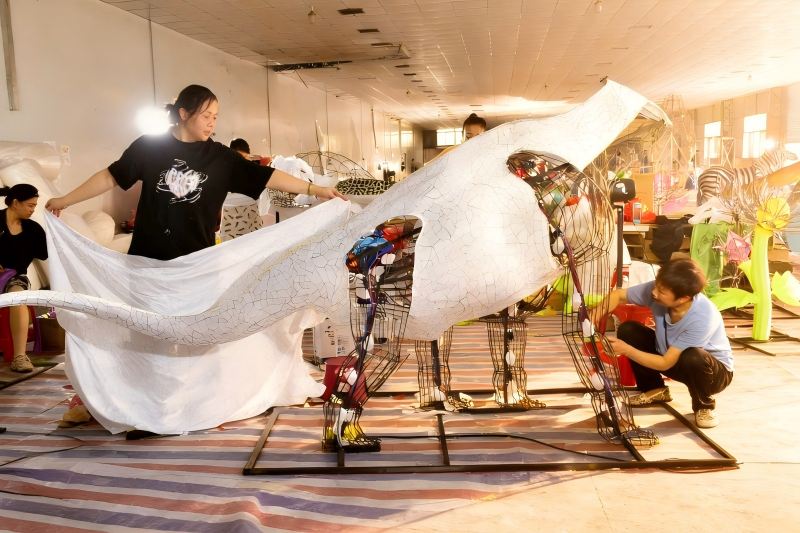
Compare the finished displays with the latest approved drawings and lantern list. Check the quantity, principal dimensions, poses, colors, supporting elements and intended viewing sides. Where a display has been revised during production, use the final agreed version. Confirm any moving or color-changing effects against the agreed scope; an open-wing pose alone does not mean a lantern is animated.
Review the display in daylight
Lanterns are often visible while venues are open during the day. Daylight photographs can reveal details that are less obvious when the display is illuminated: surface wrinkles, visible seams, uneven finishes or colors that differ from the approved design. Ask for overall views from the main visitor-facing sides and close-ups of important details. For coordinated groups, consider how the main display and supporting pieces look together.
Check the illuminated result
An illuminated photograph or video helps the buyer review the distribution of light, the clarity of outlines and the appearance of important details. Uneven brightness may be intentional, so judge the result against the approved visual effect. Where movement, interaction or changing colors are included in the order, request a demonstration of the agreed function.
Factory review helps establish the expected result, but it does not replace checks after transport, reassembly and installation. Structural, electrical and local approval requirements must be reviewed for the actual venue by the responsible qualified parties.
Confirm sections, quantities and handover information
Large displays may be divided for transport. The division must balance shipping and assembly with appearance: a prominent seam across a character’s face, for example, could affect the final view. The agreed design and project conditions determine where sections can be separated.
Before shipment, review the project-specific list of finished displays, detachable sections, packages, accessories and agreed spare parts. Record the identification of matching sections, and confirm what drawings, photographs, videos and installation guidance the site team will receive. Agree who is responsible for unloading, lifting equipment, local labor and installation support.
Project example: why the handover matters
ParkLightShow’s published Australian zoo case describes dozens of custom animal lantern groups, approximately 10 shipping containers and more than 40 days of door-to-door transportation. Large displays were made in modular sections for shipping and assembly. These are figures for that particular project, not a standard container count or delivery time; the approved design, destination and shipping arrangements affect each project. Read the Australian zoo case.
A numerical checklist for the project handover
Use the agreed order as the baseline and record actual results. The fields below are a suggested buyer worksheet, not universal acceptance limits.
| Record | Figures or identifiers to compare | Evidence to keep |
|---|---|---|
| Display quantities | Ordered, completed and outstanding quantities by design | Approved lantern list and dated overall photographs |
| Dimensions | Agreed and measured height, width and depth, with units | Drawing revision and measurement records |
| Detachable modules | Section count and matching module IDs for each display | Assembly reference and labeled section photographs |
| Packages and accessories | Package count, package IDs and agreed accessory or spare quantities | Packing list linked to display and module IDs |
| Lighting and agreed functions | Units reviewed and units requiring correction | Dated videos linked to the relevant display IDs |
| Open items | Issues recorded, corrected and still awaiting confirmation | Before-and-after evidence and named follow-up responsibility |
A matching total is not enough if the wrong parts have been counted. Keep the design, module and package identifiers connected so the receiving team can trace each item.
Record issues and confirm corrections
Mark the relevant photo or drawing when requesting a change, and describe the location and expected result. After the work is adjusted, review updated photos or video. Changes to an approved design, dimensions, structure or functions can affect cost and schedule and should be agreed with the supplier.
Frequently asked questions
Must the buyer visit the factory? Not necessarily. Depending on the project, the parties can agree to a factory visit, a remote review using photographs and video, or a combination.
Is a night video enough? Request daylight views too. They help show shape, painted color, seams and surface finish; illuminated views show the lighting result.
Is every display fully assembled before shipment? The scope of any factory pre-assembly depends on the display and the project agreement. Discuss important or complex groups before production.
What numerical tolerance or test duration applies? Agree applicable dimensions, tolerances, tests and evidence for the specific project. Do not assume one figure applies to every lantern.
HOYECHI can discuss the drawings, production-stage photos, light-up videos, assembly information and installation support appropriate to your project. Share your site plan, venue photographs, theme and intended opening date to start a discussion. Explore lantern festival solutions or contact the team.
Post time: Oct-31-2026


