
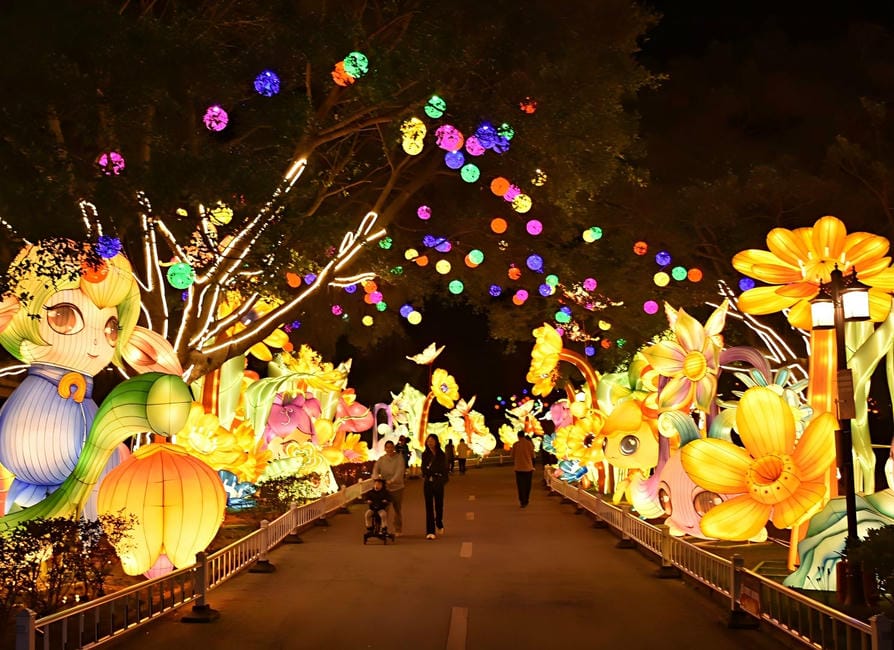
A revenue-sharing light festival partnership can be suitable for parks, zoos, farms, resorts, scenic areas, commercial complexes, and outdoor tourism venues that have visitor potential, parking or convenient access, a reasonable event season, and the ability to support local promotion and basic operations.
It is not suitable for every venue. The best projects usually come from sites that already have a visitor foundation, can manage entry or visitor flow, and want to turn nighttime hours into a ticketed or commercially valuable visitor experience.
This guide explains what a revenue-sharing light festival partnership means, the two main cooperation models, what types of venues are suitable, what conditions matter most, and what information a venue owner should prepare before discussing a project with HOYECHI.
Quick Answer: What Makes a Venue Suitable?
A venue is usually suitable for a revenue-sharing light festival partnership if it has the following conditions:
- Existing visitor traffic or strong tourism potential
- Parking, transportation access, or a realistic traffic plan
- Enough outdoor space to design a visitor route
- A reasonable event season, not only a few days
- The ability to control entry, manage tickets, or guide visitor flow
- A local team that can support promotion, ticketing, security, cleaning, and daily operation
- A willingness to cooperate on marketing and event execution
The two biggest warning signs are weak traffic access and an event period that is too short. Many operational challenges can be solved during planning, but a venue without parking, without visitor potential, and without enough operating time will be difficult to support through a revenue-sharing model.
Key Takeaways
- A revenue-sharing light festival is not just a product purchase; it is a business partnership built around visitor traffic, ticket income, and nighttime experience.
- HOYECHI can support different cooperation models depending on venue size, project potential, logistics, installation requirements, and local operation ability.
- There are two main models: a full-service revenue-sharing partnership and a shared-cost 50/50 partnership model.
- Suitable venues include parks, zoos, farms, botanical gardens, resorts, scenic areas, commercial complexes, and outdoor tourism destinations.
- Very short events and venues without parking or basic visitor flow are usually not suitable for this cooperation model.
What Is a Revenue-Sharing Light Festival Partnership?
A revenue-sharing light festival partnership is a cooperation model where a venue owner and a professional light show partner work together to create a nighttime attraction and share the project revenue according to an agreed structure.
Instead of treating a light festival only as a one-time purchase, this model focuses on creating a visitor experience that can generate ticket sales, food and retail spending, sponsorship value, tourism traffic, and long-term event potential.
For venue owners, this can reduce the pressure of making a large upfront investment before the event begins. For the light show partner, it requires deeper project involvement, including planning, design, production, logistics, installation support, route design, and event execution guidance.
If you are evaluating the overall commercial logic of this type of project, you can also review this light show business plan to understand how park light shows and outdoor light festivals can create value through ticketing, visitor flow, commercial zones, and night tourism.
Two Main Cooperation Models
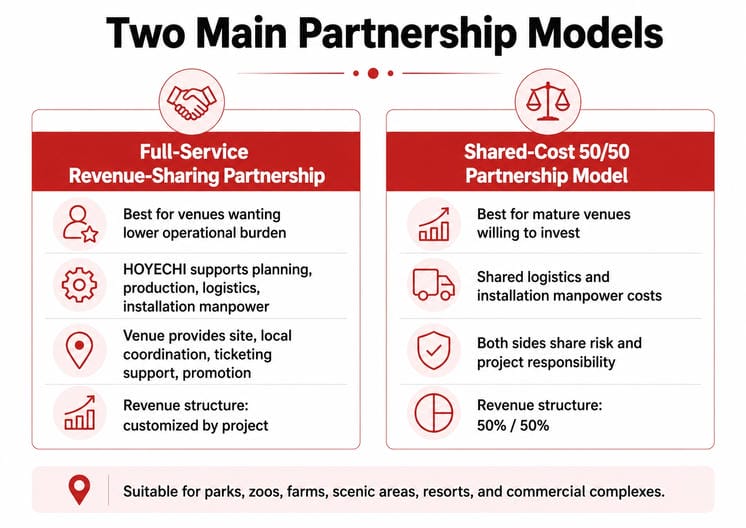
Revenue-sharing does not mean only one fixed cooperation structure. Different venues may need different models depending on project scale, local capacity, logistics cost, installation difficulty, visitor potential, and expected event duration.
HOYECHI generally discusses two types of cooperation models for suitable venues.
1. Full-Service Revenue-Sharing Partnership
The first model is a full-service revenue-sharing partnership. This model is suitable for venue owners who have a promising site but do not want to manage the full light festival project by themselves.
In this model, HOYECHI takes on more project responsibility. This may include theme planning, visitor route design, product production, logistics coordination, installation manpower, technical support, and project execution assistance.
The venue mainly provides the site, local coordination, entry or ticketing support, local permits where needed, operating staff, local marketing resources, and on-site management support.
This model is suitable when the venue has strong visitor potential but limited experience in building and operating a large outdoor light festival.
The final revenue-sharing structure depends on venue size, project investment, logistics difficulty, installation requirements, expected visitor traffic, event duration, and local operating conditions. It should be discussed case by case instead of using one fixed public formula.
2. Shared-Cost 50/50 Partnership Model
The second model is a shared-cost 50/50 partnership model.
In this model, HOYECHI and the venue owner share certain project costs, especially logistics costs and installation manpower costs. After the project opens, both sides share the project revenue on a 50% / 50% basis according to the agreed terms.
This model is often suitable for mature venue owners who are willing to participate in the project investment and want a more balanced revenue-sharing structure.
Compared with the full-service model, the shared-cost 50/50 model gives both sides a clearer joint commitment. The venue is not only providing the space, and HOYECHI is not carrying all logistics and installation pressure alone. Both parties share key costs, share risk, and share revenue.
For venues with good traffic, clear event seasons, strong local promotion ability, and a capable local operation team, this model can be a practical way to build a long-term nighttime attraction.
Partnership Model Comparison
| Model | Best For | Venue Role | HOYECHI Role | Revenue Structure |
|---|---|---|---|---|
| Full-Service Revenue-Sharing Partnership | Venues with strong potential but limited light festival execution experience | Provides site, local coordination, entry support, promotion, and basic operation | Provides planning, design, production, logistics coordination, installation manpower, and project support | Customized based on project scale, cost, visitor potential, and operating period |
| Shared-Cost 50/50 Partnership Model | Mature venues willing to share logistics and installation manpower costs | Shares key project costs and supports local operation and promotion | Shares project execution responsibility and provides light show planning, products, and technical support | 50% / 50% revenue sharing according to agreed project terms |
Which Venues Are Usually Suitable?
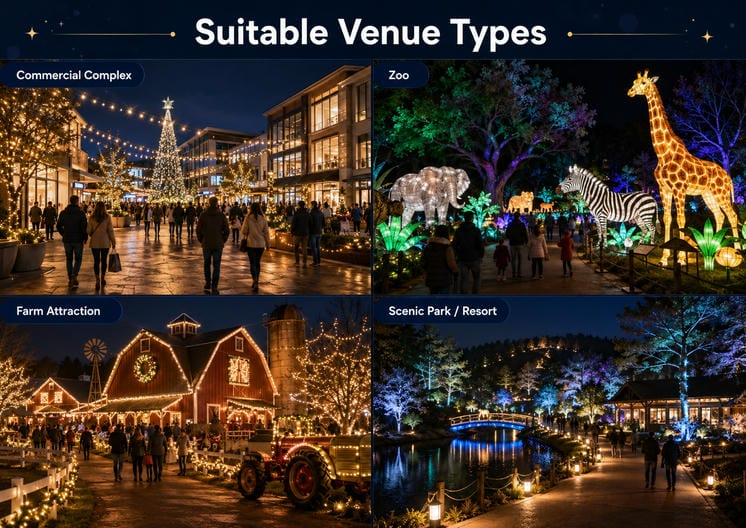
A revenue-sharing light festival partnership is most suitable for outdoor venues that already have a visitor foundation or clear tourism potential.
Suitable venue types may include:
- Parks and amusement parks
- Zoos and wildlife parks
- Botanical gardens
- Farms and family attractions
- Scenic areas and tourism destinations
- Resorts and holiday villages
- Commercial complexes with outdoor space
- Waterfront areas and outdoor plazas
- Seasonal event venues
- Outdoor cultural and tourism projects
These venues usually have one shared need: they want to extend visitor activity into the evening and create a stronger reason for people to visit after dark.
A park may want to create a winter light festival. A zoo may want to add a family-friendly lantern event. A farm may want to create a Christmas or holiday attraction. A resort may want to improve guest experience after sunset. A commercial complex may want to increase evening foot traffic and dining consumption.
For these venues, a well-structured venue partnership for light festivals can help turn existing outdoor space into a night tourism attraction.
How to Evaluate Whether Your Venue Is Suitable
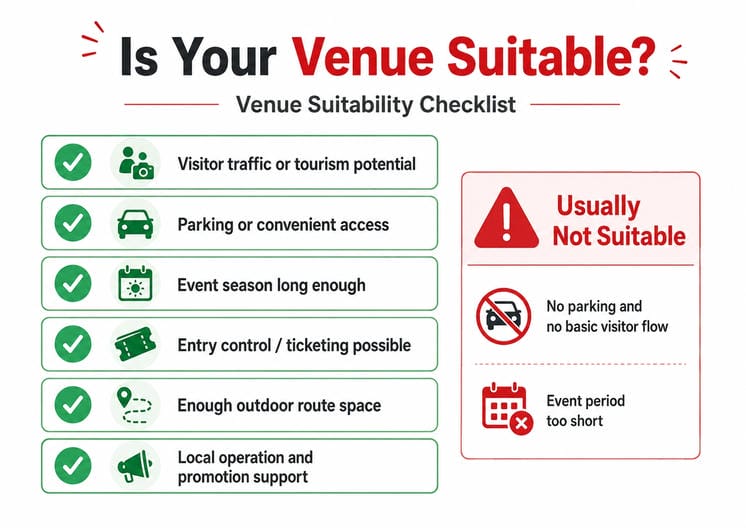
The following evaluation factors can help a venue owner understand whether a revenue-sharing light festival partnership is realistic.
| Evaluation Factor | Why It Matters | Suitable Condition |
|---|---|---|
| Visitor Potential | A light festival can increase traffic, but it should not depend on creating all traffic from zero. | The venue has existing visitors, tourism potential, local family demand, or holiday traffic. |
| Parking and Access | Visitors need a practical way to arrive, park, enter, and leave safely. | The venue has parking, nearby transportation, or a realistic access plan. |
| Event Duration | Revenue-sharing projects need enough operating time to recover costs and generate return. | The event runs for a meaningful season, not only a few days. |
| Entry Control | Ticketed projects need a way to manage admission and visitor flow. | The venue can control entry, sell tickets, or guide visitors through a defined route. |
| Outdoor Space | A light festival needs a visitor route, photo spots, landmark displays, and rest areas. | The venue has enough space for a complete walking experience. |
| Local Operation | Daily operation requires staff, security, cleaning, ticketing, and promotion. | The venue has a local team or is willing to organize one. |
1. The Venue Has Visitor Traffic or Tourism Potential
The first question is whether the venue has real visitor potential.
A light festival can create a new reason for people to visit, but it should not be expected to solve a weak location entirely by itself. The most suitable venues already have one or more traffic advantages, such as weekend visitors, local family traffic, school holiday demand, tourism groups, resort guests, nearby residents, or seasonal festival traffic.
If a venue already has daytime visitors, a light festival can give them a reason to return at night. If the venue already has local recognition, the project can use that foundation to promote a new evening experience.
2. The Venue Has Parking or Convenient Access
Parking and transportation access are critical for nighttime attractions.
Families, tourist groups, and local visitors need a convenient way to arrive, park, enter, and leave safely. If a venue has no parking, no nearby access, and no realistic traffic plan, the project risk becomes much higher.
A venue does not need to be perfect, but it should have a workable plan for visitor arrival, parking, traffic flow, and safe exit after dark.
3. The Venue Can Control Entry or Manage Visitor Flow
Revenue-sharing works best when the venue can control entry, sell tickets, manage admission, or guide visitors through a planned route.
This does not always require a fully closed park. However, there should be a practical way to manage visitor flow and connect the light festival with ticketing or commercial value.
For free-entry commercial venues, the model may focus more on foot traffic, sponsorship value, food and retail spending, brand exposure, or tenant support instead of direct ticket income.
4. The Venue Has Enough Space for a Visitor Route
A successful light festival is not only a group of illuminated displays. It is a designed visitor journey.
The route should include an entrance impression, themed lighting scenes, landmark displays, photo spots, rest areas, commercial points, and a strong final memory. The site does not need to be extremely large, but it should be able to support a complete walking experience.
Professional light show planning can help organize the venue into a visitor-friendly route instead of a random display area.
5. The Venue Has Local Operation Support
Even if HOYECHI provides design, products, installation support, and technical guidance, the venue still plays an important role in local operations.
The venue should be able to support ticketing, entrance control, staff coordination, security, cleaning, local promotion, food and retail arrangement, and communication with local authorities if needed.
Most operational challenges can be solved through planning and training, but the venue must be willing to participate in the project operation.
6. The Event Season Is Long Enough
Revenue-sharing projects need enough operating time to recover costs and generate profit.
A very short event of only a few days is usually not suitable because design, production, logistics, installation, promotion, operation, and maintenance all require time and investment.
The best event periods are usually connected with Christmas, winter tourism, school holidays, local festivals, national holidays, seasonal family activities, or tourism peak periods.
What Makes a Venue Less Suitable?
Many project challenges can be solved during planning. Power supply can be improved. Visitor routes can be redesigned. Entrance control can be adjusted. Installation can be supported. Promotion can be planned. Operation teams can be trained.
However, two limitations are more difficult to overcome.
No Parking and No Basic Visitor Flow
If a venue has no parking, no convenient access, and no existing visitor foundation, the project risk becomes much higher.
A light festival can increase visitor interest, but it should not be expected to create all demand from zero. Without access and visitor potential, marketing costs may become too high and the event may not reach the expected attendance.
The Event Period Is Too Short
A very short event is usually not suitable for a revenue-sharing light festival partnership.
Large outdoor light festivals require planning, production, transportation, installation, testing, promotion, operation, and maintenance. If the event only runs for a few days, it may be difficult for both sides to achieve a reasonable return.
For short events, a standard purchase, rental-style arrangement, or smaller lighting package may be more practical than a full revenue-sharing partnership.
What the Venue Usually Provides
In a revenue-sharing partnership, the venue provides the local foundation for the project.
The venue usually supports:
- Outdoor site or event space
- Local permits or authority coordination when needed
- Entrance management or ticketing support
- Local promotion resources
- Basic operation team
- Security and visitor management
- Cleaning and on-site service support
- Food, retail, or commercial cooperation if available
- Parking and traffic arrangement
The stronger the venue’s local support, the easier it is to create a successful light festival.
What HOYECHI Usually Provides
HOYECHI provides the design, production, installation, and project execution experience needed to turn an outdoor venue into a nighttime attraction.
Depending on the cooperation model, HOYECHI may provide:
- Project concept and theme planning
- Visitor route design
- Lighting display design
- Custom lanterns and light sculptures
- Factory production and quality control
- Logistics coordination
- Installation manpower or installation guidance
- Technical support
- Maintenance advice during the event
- Upgrade suggestions for future seasons
For large outdoor venues, this support is important because a light festival is not only a decoration project. It is a complete visitor experience and commercial operation.
Information to Prepare Before Contacting HOYECHI
Before discussing a revenue-sharing partnership, it is helpful to prepare basic venue and project information. This allows HOYECHI to evaluate whether the venue has real potential and which cooperation model may be suitable.
Useful information includes:
- Venue name and location
- Venue size or available event area
- Photos, videos, or a site map
- Current visitor traffic or seasonal visitor data
- Expected event season and operating dates
- Ticketing possibility or entry control conditions
- Parking and transportation conditions
- Available power supply information
- Local promotion resources
- Existing food, retail, or commercial areas
- Preferred cooperation model
- Estimated project goals
The more complete the information, the easier it is to evaluate the project and avoid unrealistic expectations.
Why Revenue-Sharing Is Not Only About Lower Cost
Many venue owners first become interested in revenue-sharing because it can reduce upfront pressure. However, the real value of the model is not only cost reduction.
A good partnership can help the venue reduce trial-and-error costs, improve project planning, avoid unsuitable display choices, create a better visitor route, and connect the light festival with ticketing, food, retail, and commercial goals.
In other words, revenue-sharing is not simply a cheaper way to get a light show. It is a cooperative business model that requires both sides to think about visitors, operations, promotion, safety, and long-term results.
FAQ: Revenue-Sharing Light Festival Partnerships
What is a revenue-sharing light festival partnership?
A revenue-sharing light festival partnership is a cooperation model where a venue and a light show partner work together to launch an outdoor light festival or park light show and share the project revenue according to agreed terms.
What types of venues are suitable for this model?
Parks, zoos, farms, botanical gardens, resorts, scenic areas, commercial complexes, outdoor plazas, and tourism destinations may be suitable if they have visitor potential, parking or access, a reasonable event season, and local operation support.
What is the difference between the full-service model and the 50/50 model?
In the full-service model, HOYECHI takes on more project responsibility, including planning, production, logistics, installation manpower, and execution support. In the shared-cost 50/50 model, the venue and HOYECHI share key costs such as logistics and installation manpower, then share revenue on a 50% / 50% basis according to agreed terms.
Is a small venue suitable for revenue-sharing?
A small venue may be suitable if it has strong visitor traffic, good access, clear entry control, and a long enough event period. However, a very small venue with weak visitor flow may be better suited for a standard purchase or smaller lighting package.
Can power supply problems be solved?
In many cases, yes. Power supply should be evaluated during the planning stage. The project can be adjusted based on available electricity, route layout, display size, and technical requirements.
Is a short event suitable for this model?
Usually not. Revenue-sharing light festival projects need enough operating time to recover costs and generate return. If the event lasts only a few days, a standard purchase, rental-style arrangement, or smaller project may be more practical.
What is the most important condition for a suitable venue?
The most important conditions are visitor potential, parking or access, event duration, local promotion ability, and basic operation support. A light festival can strengthen a venue, but it should be built on a realistic visitor foundation.
Does the venue need previous light festival experience?
No. Many venues do not have previous light festival experience. With proper planning, route design, installation support, and operation guidance, many challenges can be solved. However, the venue should have a local team willing to support daily operation and promotion.
Final Thoughts
A revenue-sharing light festival partnership can help parks, scenic areas, zoos, farms, resorts, and commercial outdoor venues launch a nighttime attraction with a more flexible business structure.
However, the model is not suitable for every site. The strongest projects usually come from venues with good access, parking, visitor potential, a reasonable event season, and a local team willing to support promotion and operation.
Whether you choose a full-service revenue-sharing partnership or a shared-cost 50/50 partnership model, the key is to evaluate the venue carefully before starting. A successful light festival is not only about beautiful displays. It is about matching the right venue, the right business model, the right visitor route, and the right operating plan.
If your venue has the potential to become a night tourism attraction, a partnership model may help you turn that potential into a real event.
Discuss a Partnership Model with HOYECHI
HOYECHI works with parks, scenic areas, zoos, farms, resorts, and commercial venues to plan and deliver custom outdoor light festivals, park light shows, and night tourism attractions.
If you are evaluating whether your venue is suitable for a revenue-sharing light festival partnership, you can contact HOYECHI with your venue information, site photos, expected event season, parking conditions, and preferred cooperation model.
Our team can help review your venue potential and discuss whether a full-service partnership, a shared-cost 50/50 model, or a standard project plan is more suitable.
Post time: Jun-20-2026


