
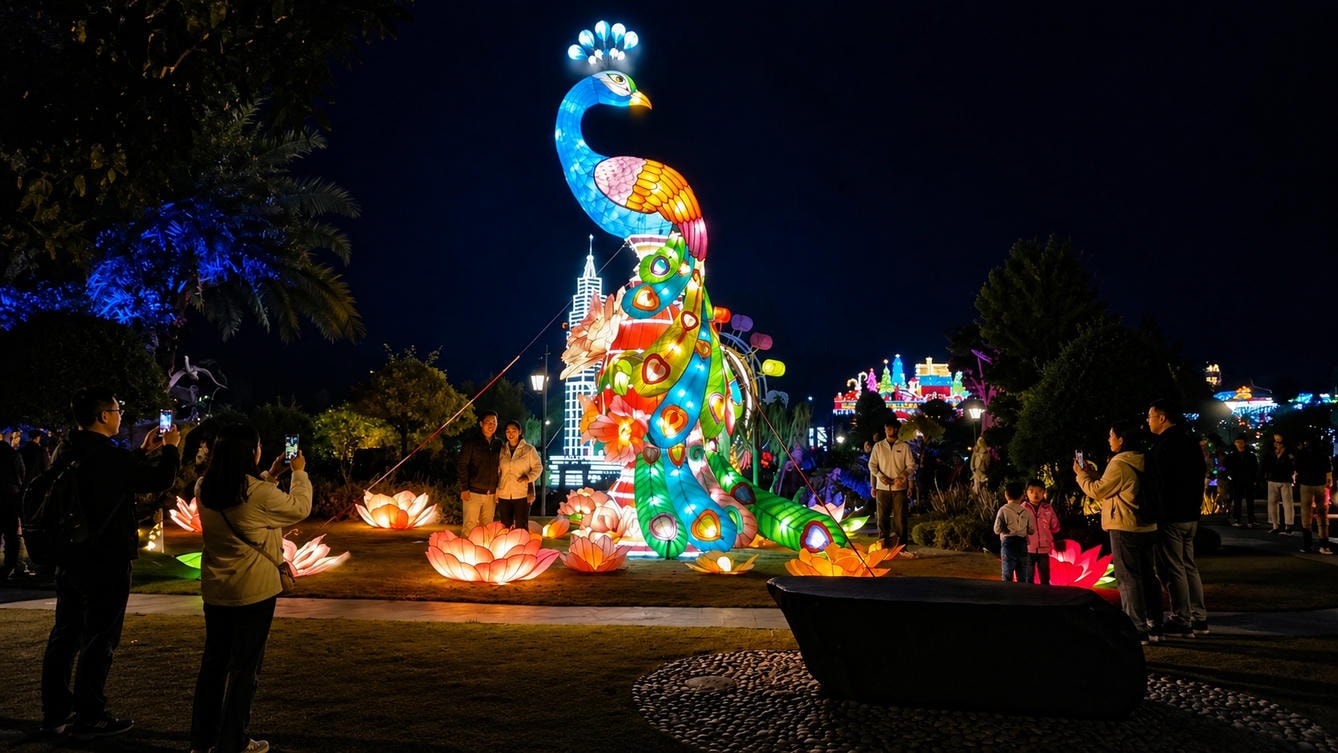
A giant peacock lantern display should begin with its visual role, not with an arbitrary size. It may act as a recognizable landmark, become the center of a floral scene, or use an expanded tail to create a broad transition image. The pose, viewing direction, color plan, surrounding forms, and choice between a static or moving tail should all follow that role.
Before requesting a quotation or effect rendering, define four points: where the peacock will stand, where people will see it from, whether it is the main feature or part of a larger scene, and which theme should connect it to the surrounding displays. These decisions provide a more useful design basis than a universal list of dimensions.
HOYECHI has produced peacock lantern displays for projects in Malaysia and Singapore. Confirmed formats include fixed static displays and dynamic peacocks whose illuminated tails can open and close. To protect customer and project privacy, this article does not identify the projects, venues, cities, dates, quantities, or results.
Choose the Peacock’s Role in the Scene
A peacock differs from many animal lanterns because the body is only one part of the visual center. The tail may occupy much more of the composition. If the design concentrates only on the head and body, the tail can look like an attached background. If it concentrates only on tail size, the bird may lose a convincing pose.
A useful concept treats the body, tail, and surrounding scene as one composition. Buyers can begin with one of the following six directions and then develop the details around the selected role.
1. A static full-tail landmark
A fully expanded static tail creates strong frontal recognition and can establish the peacock as the centerpiece of a zone. It benefits from a clear primary viewing direction and enough contrast behind the silhouette so the tail does not merge with nearby displays.
The first design priority is not to fill every feather with maximum detail. Establish the outer contour, large color areas, and repeated visual rhythm first. From a distance, people read the overall shape; closer views reveal the feather patterns, color transitions, and smaller decorative elements.
2. A dynamic tail that opens and closes
A moving peacock can create a visible change as its tail opens and closes. The visual review should not examine only the fully open moment. It should also consider the closed position, the intermediate movement, and the relationship between the body and tail throughout the visible sequence.
Movement is not an automatic upgrade over a static display. It introduces project-specific questions about the mechanism, control, operating conditions, and maintenance responsibility. The choice should follow the display role, budget priorities, and operating context. This article explains the visual distinction; it does not prescribe a universal mechanical system or promise performance.
3. A side-view or partially open composition
A side-view peacock emphasizes the line of the neck, the body posture, and the direction in which the tail extends. It can suit a longer viewing face or a position beside a path, planted area, or architectural background.
A partially open tail sits between a landmark and a supporting scene element. It avoids concentrating all visual weight in one circular tail and can leave room for flowers, figures, or other animal lanterns to remain visible in the same composition.
4. A pair or group of peacocks
Two or more peacocks should not be treated as identical objects placed side by side without a hierarchy. The composition needs a lead form: which peacock establishes the highest or widest silhouette, which changes direction or posture, and how the surrounding forms connect the group.
If every peacock uses the same size, direction, and color distribution, the scene may appear flat. Changes in posture, orientation, tail state, and color emphasis can keep the group visually related without making it mechanically repetitive.
5. A peacock with flowers and natural forms
Peacock lanterns can be combined with different flowers, leaves, water-inspired forms, and other plant elements. Lotus forms may suit some themes, but they are not a required or default pairing. HOYECHI’s design direction follows the project theme, site, and client preference rather than applying one fixed floral package.
Lower flowers can connect the body to the ground plane. Taller plant forms may balance the sides of the tail. Repeated smaller color points can carry the peacock’s palette into the surrounding scene. These relationships should be planned in the effect rendering instead of added after the main figure is complete.
6. A tail developed as a spatial feature
In some concepts, the tail can be enlarged, extended, or reorganized as a backdrop, frame, or transition feature. A broad tail may help define an entrance view or connect one scene to the next, but that visual idea cannot simply be copied from one venue to another.
If a concept crosses a public route, creates an overhead form, or introduces a large projection, the actual clearance, structure, foundation, wind, electrical, fire, and installation questions must be reviewed for the specific site by the responsible qualified parties. An effect rendering does not replace those decisions.
Review Six Visual Questions Before Approving the Rendering
Is the silhouette still clear from a distance?
Reduce the rendering or view it from farther away. If the neck, body, and tail still read as a peacock without relying on small feather patterns, the basic relationship is working. Additional detail rarely solves a weak outer contour.
Is the tail balanced with the body?
The tail may be the main visual feature, but the body should not look like an accidental attachment. Conversely, an oversized body and undersized tail can weaken the feature that makes the display recognizable. Judge the proportion according to the intended viewing distance and visual role rather than one fixed ratio.
Is the primary viewing direction defined?
A frontal fan, angled fan, and side-view form create different impressions. Mark the expected viewing positions on the site plan and review what appears from the side and rear as well. A design that works only from one rendering angle may expose an unfinished-looking area at the venue.
Do the colors support the hierarchy?
A peacock lantern may use blue, green, purple, gold, red, or another project-led palette. More colors do not automatically improve the result. Use the dominant relationship to separate the body from the tail, then apply repeated accents to create a feather rhythm. Review the illuminated appearance separately because daytime surface color and nighttime transmitted color are not identical visual conditions.
Do the supporting forms strengthen the peacock?
Flowers, leaves, water forms, and background lanterns should help viewers read the scene instead of competing with the main subject. A useful hierarchy lets the viewer notice the peacock first, the tail details second, and the environment third. If every form is equally bright, equally large, and equally complex, the focal point disappears.
Does the quantity have a compositional reason?
One large peacock may serve as a landmark. A pair can create a wider scene, while several smaller birds may support a sequence. Quantity should follow the composition, available area, and budget priority—not the desire to make a product list appear longer.
What Buyers Should Provide Before the Effect Rendering
| Starting information | Why it matters |
|---|---|
| Venue type and site plan | Shows whether the peacock is a landmark, route node, entrance background, or part of a grouped scene |
| Photographs of the available area | Reveals background colors, buildings, planting, and existing visual competition |
| Primary viewing directions | Guides the pose, tail orientation, and amount of side or rear treatment |
| General theme and intended atmosphere | Helps distinguish realistic, decorative, traditional, contemporary, or fantasy-led visual language |
| Intended role of the peacock | Defines whether it leads the scene, forms a pair, supports a garden group, or creates a transition |
| Liked and disliked references | Clarifies preferences for pose, tail shape, color, and composition without asking to copy another project |
| Target opening time | Gives later design, production, transport, and installation discussions a shared time context |
| Budget range, if available | Helps prioritize the main form, supporting pieces, movement, and visible detail |
When sending references, explain what each image is meant to communicate. A buyer may like the outline of one tail, the posture of another bird, and the color relationship in a third image. That is more useful than sending one image with a request to reproduce it exactly. It also gives the project a clearer path toward its own composition.
For the broader sequence from site information to an approved visual plan, see ParkLightShow’s guide to the custom lantern festival design process.
Visual Approval Is Not Complete Project Approval
An effect rendering can help confirm the peacock’s visible shape, proportion, color, quantity, grouping, and primary viewing direction. It cannot, by itself, confirm materials, internal structure, modules, foundations, electrical connections, transport dimensions, installation methods, or local public-space requirements.
Once the visual direction is stable, the project can move into the appropriate engineering and production-information stages. The purpose of that sequence is to avoid fixing downstream work while the main form is still changing. Each technical decision remains subject to the agreed project scope and review by the responsible parties.
Frequently Asked Questions
What is a giant peacock lantern display?
It is a large illuminated art form or grouped lantern scene based on a peacock. It may be used as a festival landmark, cultural or themed display, commercial centerpiece, or part of a broader floral and animal composition. The final format is determined by the approved project concept.
How should a buyer choose between a static peacock and a moving tail?
A static peacock keeps one defined display position, making it easier to compose the surrounding scene around a fixed silhouette. A moving version adds visible tail movement but introduces project-specific mechanism, control, operating, and maintenance questions. The choice should follow the visual role, budget priorities, and operating context.
Which flowers or natural elements can be combined with a peacock lantern?
The design may use different flowers, leaves, water-inspired forms, or other natural elements according to the theme. Lotus is one possible option, not a default requirement. Keep the peacock as the first visual layer, then use the supporting forms to connect colors and fill the lower scene.
How should buyers choose the color direction?
Begin with one dominant color relationship and then define the repeated colors and accents in the tail. Review the palette against the venue background and in the intended illuminated condition. Avoid distributing every bright color equally if doing so removes the visual hierarchy.
What information is needed before a custom concept is prepared?
Provide the venue type, site plan or available area, site photographs, main viewing directions, general theme, intended role of the peacock, reference preferences, and target opening time. Approximate dimensions, quantity, and budget priorities can then be discussed against that context.
Does an effect rendering confirm structural and electrical requirements?
No. A rendering confirms visible design direction. Structure, foundations, wind, electrical systems, fire considerations, modules, transport, and installation requirements must be reviewed for the actual project by the relevant technical teams and qualified local parties.
Plan the Peacock as Part of a Complete Lantern Festival
If the peacock is a standalone feature, begin with its location, viewing direction, and visual role. If it will become a major landmark for a wider event, relate it to the entrance, theme zones, surrounding lantern groups, and overall project brief. Prepare the site plan, photographs, theme, target opening time, and reference direction, then continue through HOYECHI’s Lantern Festival project page to organize the broader requirement.
Post time: Sep-03-2026


