
A lantern sculpture and an LED wireframe display can start from the same animal, plant, or object reference and still produce very different visual results. Before you compare prices or suppliers, it helps to decide which visual result you are actually looking for: a covered, glowing volume that reads as a solid form, or an open outline drawn in light where you can see through the shape.
For a park, zoo, botanical garden, or commercial lantern festival, naming that difference early reduces the chance of describing one idea while ordering another. This guide explains how the two visual formats read at night, why the same reference photo can be understood differently, and what to include when you describe what you want.
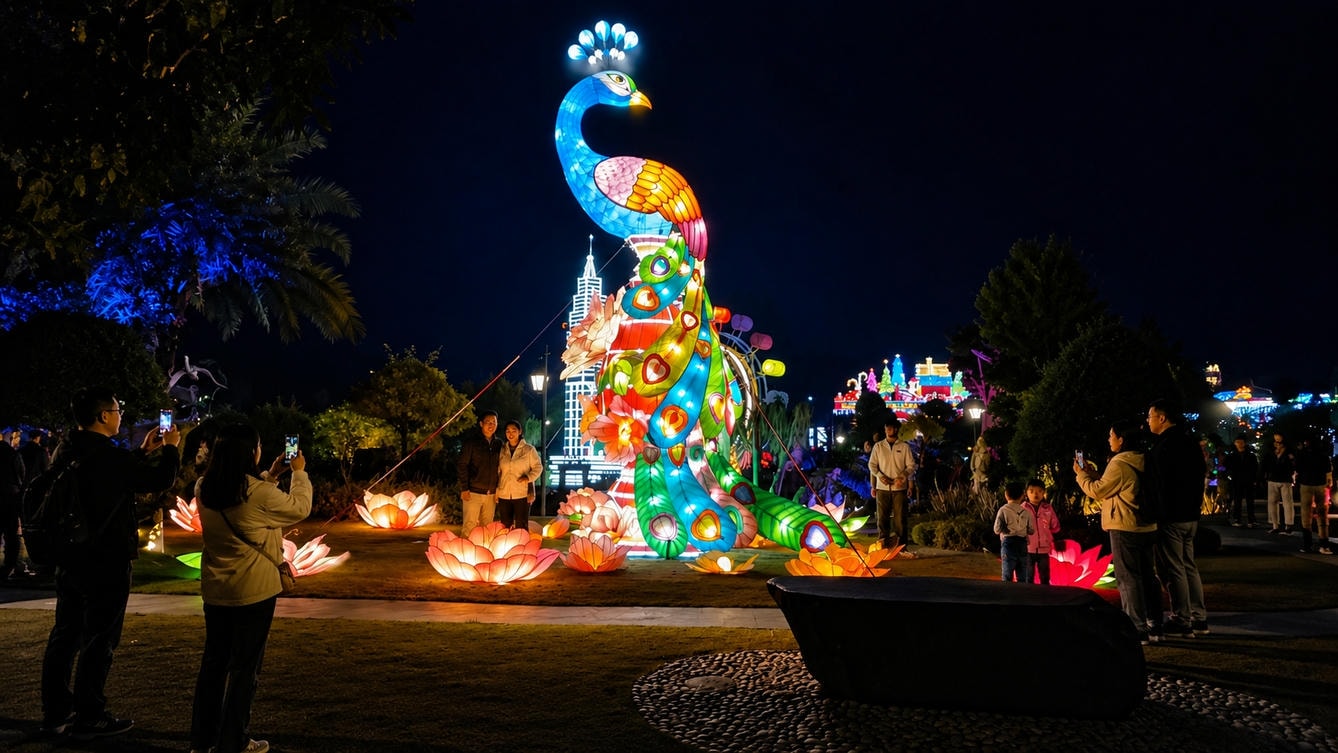

Two Visual Results: Covered Form vs. Open Outline
A covered lantern form presents a continuous surface. The shape is built as a volume, the surface is finished so the form reads as a solid object, and light makes that surface visible at night. When you look at it, you see the body of the animal, plant, or object as a mass, and the surface carries the color and detail. This is the visual language most commonly associated with a Chinese lantern festival display.
An LED wireframe display presents an open outline. The form is drawn with light along the edges or structural lines, and the space inside the outline remains open. From most viewing angles you can see through the shape to the background, so the result reads as a line drawing in light rather than a solid body. The same subject can be suggested by a few glowing lines instead of being filled in.
These are visual descriptions, not a claim that every lantern festival uses only one of them. Both formats can use LEDs, both can be built as custom designs, and both can be three-dimensional. The difference you are choosing is how the form appears: as a covered, glowing volume or as an open, see-through outline.
Why the Same Reference Can Be Read Differently
A reference photo rarely tells a supplier everything. Suppose you send a photo of a deer: one supplier may imagine a covered deer lantern with a finished surface, while another may picture an open wireframe deer drawn in light. Both can reasonably call the result “a deer display,” but the night-time appearance is not the same.
The same is true for flowers, birds, mascots, and architectural subjects. The reference communicates the subject and general pose; it does not automatically communicate surface treatment, how much of the form is filled, or whether the viewer can see through it. Saying which visual result you want is what makes the reference useful.
What to Describe When You Send a Reference
When you describe the visual format you want, you can stay in visual language. You do not need to specify manufacturing method or lighting hardware to be understood.
| What to explain | Example wording |
|---|---|
| Surface | Do you want a solid, finished surface, or lines and open space? |
| Volume | Should the form read as a full body, or as a suggestion of the shape? |
| Outline | Do you want a complete outline, or selective lines that suggest the subject? |
| See-through | Should viewers see through parts of the form, or does it block the view? |
| Viewing distance | Will people view it from a distance, close up, or while walking through? |
Using this kind of language helps a supplier confirm the visual direction before moving to structure, materials, and cost. It also helps you compare different proposals against the same visual goal instead of against different interpretations of your reference.
A Quick Comparison of the Two Visual Formats
| Visual feature | Covered lantern form | LED wireframe display |
|---|---|---|
| How the form reads | Solid, glowing volume | Open outline drawn in light |
| See-through effect | Mostly opaque from normal viewing angles | Often see-through between the lines |
| Surface detail | Color and detail carried on the surface | Detail comes from line placement and light |
| Background interaction | Blocks or frames what is behind it | Reveals what is behind it |
| Night-time character | Reads as a mass of light | Reads as a light drawing |
This table compares visual character only. It is not a statement that one format is cheaper, more durable, more energy-efficient, safer, or easier to maintain. Those questions depend on the actual design, scale, setting, and agreed scope of a specific project.
How to Take This into a Lantern Project Discussion
Once you have described the visual result, the conversation can move to the project itself: the venue, the intended viewing areas, the theme, and how the display relates to the surrounding lantern festival displays. For custom designs, the usual path is a custom lantern design process, where the visual direction is confirmed before production details are fixed.
If you are comparing suppliers, ask each one to confirm how they would achieve the visual result you described. A proposal is easier to compare when it states the surface, volume, and see-through character you asked for, rather than when it assumes a format from a reference photo.
FAQ
Is an LED wireframe display the same as a standard LED light display?
Not necessarily. A wireframe display is defined by its open, outline-like visual form. A standard LED light display can describe many arrangements, including covered forms that use LED lighting. The useful question is which visual result you want, not which label the display carries.
Do covered lanterns always use LEDs?
No. Covered lantern forms can use different lighting arrangements depending on the design and project. LEDs are common, but the choice of lighting is a project decision, not an automatic feature of the format.
Can a wireframe form still be custom-made?
Yes. Open wireframe forms can be designed around a specific subject, scale, and composition, just as covered forms can. Custom capability is a separate question from the visual format you select.
Which format is better for a night attraction?
There is no universal answer. The right choice depends on the venue, the viewing context, the effect you want at night, and the project scope. Describing the visual result you want is more useful than asking which format is “better.”
Tell us about your lantern display idea: share your venue, the reference or visual result you want, and the features you want to preserve, and we can discuss how that fits a custom lantern project.
Post time: Oct-27-2026


