
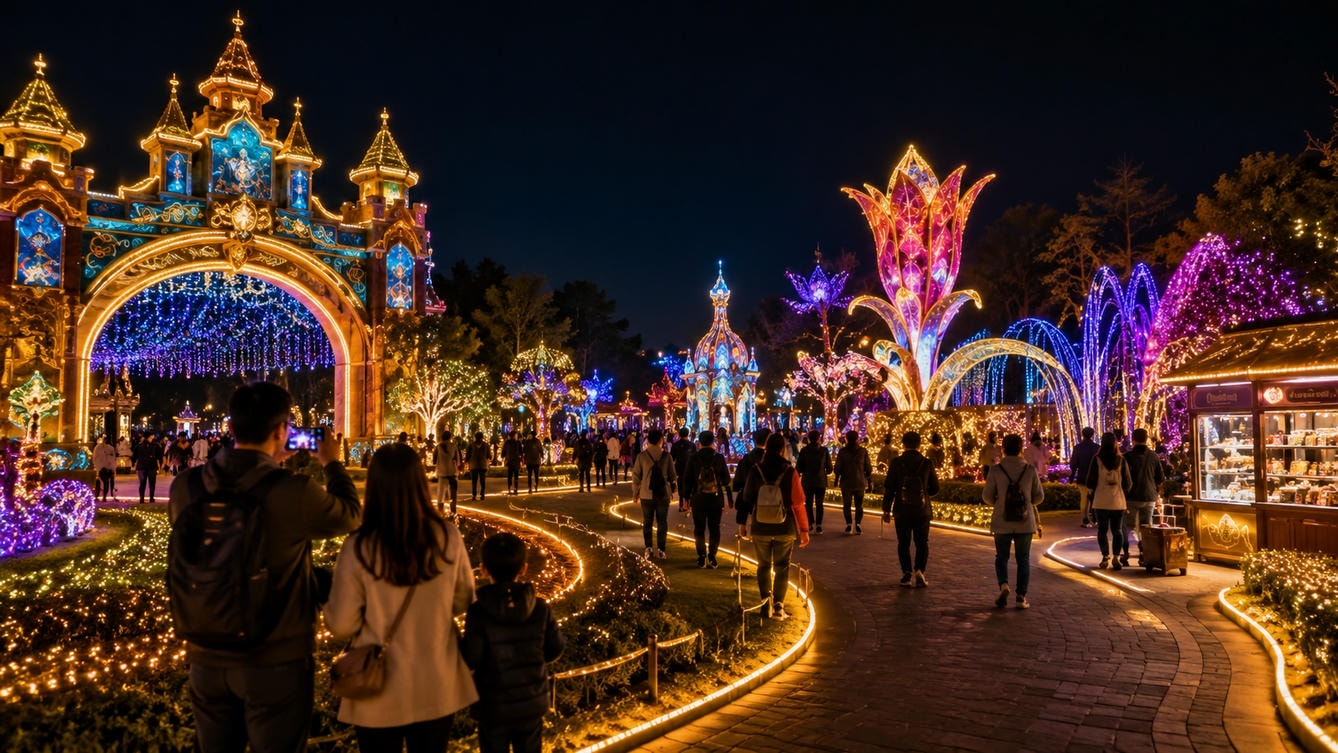
A successful park light show is not created by placing beautiful lights everywhere. It is created by guiding visitors through a complete nighttime journey.
For parks, scenic areas, zoos, farms, resorts, and outdoor venues, visitor route design can directly affect ticket value, crowd flow, photo sharing, food and retail spending, safety, and overall visitor satisfaction. If the route is confusing, too short, too crowded, or disconnected from commercial zones, even a visually impressive light show may fail to create strong business results.
That is why professional light show planning should begin with one important question: how should visitors move, stop, take photos, rest, spend, and remember the experience?
This article explains how to design a visitor route for a profitable park light show, especially for outdoor venues that want to turn nighttime hours into real visitor value.
01 Start with the Business Goal, Not the Decorations
Many venues begin planning a light show by asking: “What displays should we buy?”
A better question is: “What business result should this route create?”
Different venues need different route strategies. A ticketed park light show must make visitors feel the experience is worth the admission price. A free-entry commercial light show must guide people toward restaurants, retail shops, cafés, and photo zones. A scenic area light show may need to extend visitor stay time and create a stronger tourism image. A zoo or botanical garden may need a route that supports education, family interaction, and seasonal storytelling.
Ticketed Route Goal
Create enough visual value, walking time, photo opportunities, and emotional memory to justify the ticket price.
Traffic-Driven Route Goal
Attract visitors into the venue and guide them naturally toward food, retail, entertainment, and commercial spending areas.
Without a clear business goal, the route may become only a collection of light displays. With a clear goal, every installation has a purpose.
02 Build a Strong Entrance Impression
The entrance is the first selling point of a park light show.
Visitors should immediately feel that they are entering a special nighttime experience. A weak entrance makes the whole event feel ordinary, while a strong entrance helps build expectation and encourages people to take their first photos before they even begin the route.
A good entrance area can include:
- A large illuminated arch or themed gateway
- A clear project name or branded landmark
- Warm welcome lighting
- Simple wayfinding signs
- Photo-friendly space that does not block traffic
The entrance should not only be beautiful. It must also control movement. Visitors should know where to enter, where to queue, where to scan tickets, and where the main route begins.
For a lantern festival for parks, the entrance can also introduce the main theme, such as animals, Christmas, butterflies, flowers, fantasy forests, cultural stories, or local landmarks.
03 Use Landmark Displays to Pull Visitors Forward
A good route should make visitors want to keep walking.
This is where landmark displays become important. Large light sculptures, giant lanterns, illuminated castles, animal installations, tunnels, themed trees, and oversized photo scenes can be placed at key points to visually pull visitors forward.
Visitors should always be able to see or sense the next highlight. If the route feels empty for too long, people may lose interest or turn back early.
Good Route Rhythm
Entrance → first highlight → photo zone → walking transition → main landmark → rest area → commercial zone → finale.
Weak Route Rhythm
Beautiful displays appear randomly, with no clear direction, no visitor flow logic, and no emotional climax.
The best park light show routes are not flat. They create rhythm. Small scenes support large scenes. Quiet walking sections prepare visitors for the next visual surprise.
04 Place Photo Spots Where Visitors Naturally Stop
Photo spots are not just decoration. They are marketing points.
When visitors take photos and videos, they help promote the event through social media. For many outdoor venues, this organic sharing can become one of the most valuable parts of a night tourism project.
However, photo spots must be placed carefully. If they are too close to narrow paths, they can block traffic. If they are hidden in low-traffic areas, visitors may miss them. If they are too small, they may not look impressive in photos.
Good photo spot locations include:
- Near the entrance, but not blocking the queue
- At wider parts of the walking route
- Near rest areas or food zones
- Before or after a major landmark display
- At scenic viewpoints, lawns, plazas, or lakeside areas
A strong photo spot should allow visitors to stand safely, take clear photos, and capture both people and the light installation in the same frame.
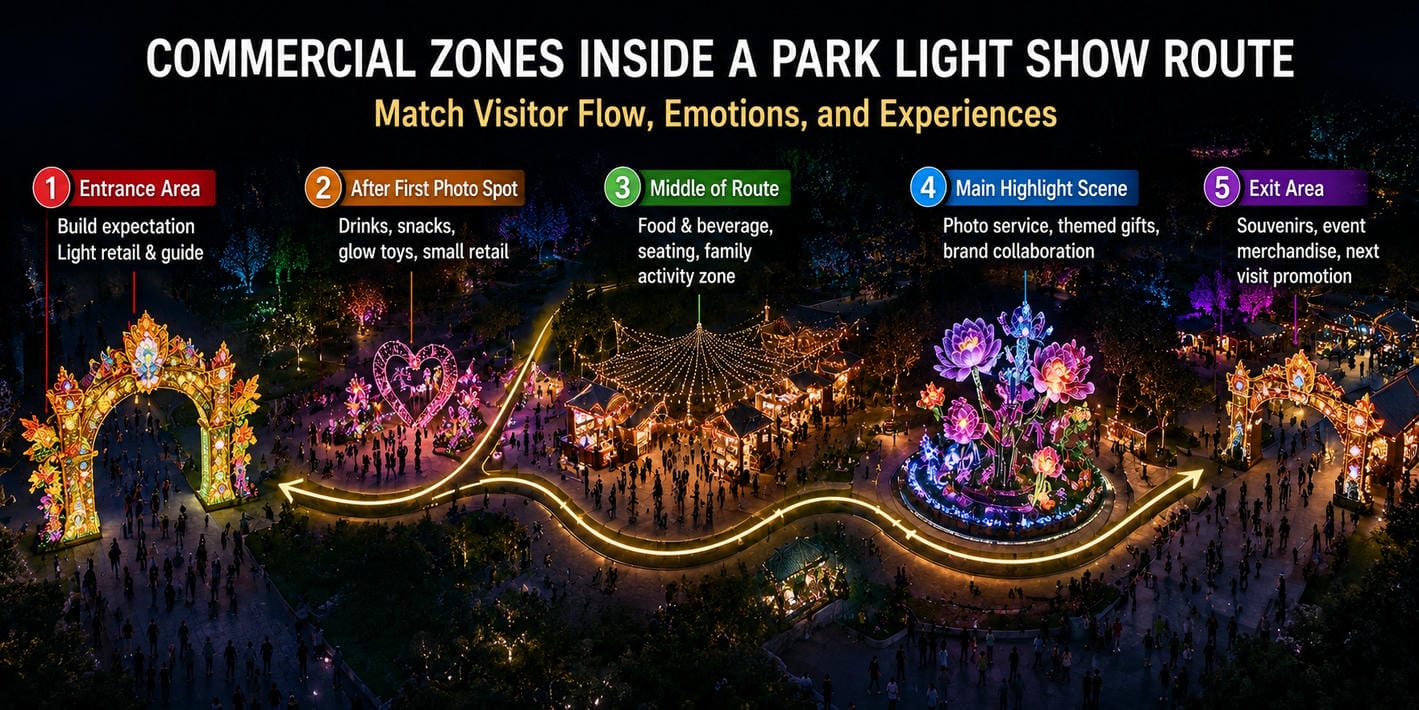
05 Connect Food, Retail, and Rest Areas with the Route
A profitable park light show should not separate visitor experience from commercial value.
If food stalls, souvenir shops, cafés, retail booths, or brand sponsor areas are placed outside the natural route, many visitors will simply miss them. But if commercial zones are placed where visitors naturally slow down, they can increase revenue without feeling forced.
The best locations for commercial zones are usually:
- After visitors have walked for a while
- Near a large photo spot
- Near restrooms or seating areas
- Before the second half of the route
- Near the exit, for souvenirs and last-minute purchases
For commercial plazas, resorts, and shopping districts, this part is especially important. A free light show may not generate ticket income, but it can still create strong value by increasing foot traffic, dwell time, restaurant visits, retail sales, and brand exposure.
06 Avoid Dead Ends and Confusing Paths
One of the most common problems in outdoor light show planning is route confusion.
Visitors should never ask themselves: “Where should we go next?”
Dead ends, narrow turns, unclear intersections, repeated scenes, and poorly marked exits can reduce visitor satisfaction. They can also create crowding and safety problems.
To avoid this, the route should be designed with clear movement logic:
- Use one main direction whenever possible
- Avoid forcing visitors to walk back through the same area
- Use lighting, arches, signs, and landmarks as natural guides
- Keep emergency access and service paths separate where possible
- Make the exit easy to find but not too sudden
For a large scenic area light show, route planning should also consider terrain, slopes, water areas, bridges, parking distance, and visitor transportation inside the venue.
07 Control Crowd Flow for Safety and Comfort
A park light show should feel lively, but not chaotic.
If too many visitors gather in one place, the experience becomes uncomfortable. Families with children, elderly visitors, and tourists taking photos all need enough space to move safely.
Crowd flow can be improved by:
- Creating wider spaces around major landmarks
- Separating photo-taking areas from walking paths
- Using multiple medium-sized attractions instead of only one large attraction
- Placing rest areas away from narrow route sections
- Adding staff guidance at busy intersections
- Using timed entry for large ticketed events
Safety planning should begin before production and installation. Outdoor lighting projects must consider weather, power supply, cable protection, ground conditions, emergency routes, and maintenance access.
08 Design a Route That Can Be Reused and Upgraded
A profitable park light show should not only work for one season. It should create long-term value.
Many venues can reuse major displays, modular structures, tunnels, arches, and themed installations for future events. The route can also be upgraded year by year by changing themes, adding new photo spots, improving commercial zones, or expanding the walking distance.
This is especially important for parks, farms, zoos, and resorts that want to build an annual event.
A reusable route strategy can help reduce future costs and improve return on investment. Instead of starting from zero every year, the venue can keep the strongest parts of the original project and add new highlights to encourage repeat visits.
Visitor Route Planning Summary
| Route Element | Main Purpose | Business Value |
|---|---|---|
| Entrance Area | Create first impression and guide entry | Improves perceived ticket value and photo sharing |
| Landmark Displays | Pull visitors forward through the route | Increases completion rate and visitor satisfaction |
| Photo Spots | Encourage photos and social sharing | Creates organic promotion and repeat interest |
| Food and Retail Zones | Connect visitor flow with spending areas | Supports food, retail, souvenir, and sponsor income |
| Rest Areas | Improve comfort and extend stay time | Helps families and groups stay longer |
| Finale Scene | Leave a strong final memory | Improves reviews, sharing, and return visits |
FAQ: Park Light Show Route Design
How long should a park light show route be?
The ideal route length depends on the venue size, visitor type, ticket price, and project budget. For small venues, a compact but high-density route may work better. For large parks or scenic areas, the route can be longer, but it must include enough highlights, rest points, and clear guidance to keep visitors engaged.
Should the route be circular or one-way?
A one-way circular route is usually better for crowd control because it reduces visitor confusion and prevents traffic from moving in opposite directions. However, the final design should follow the actual site conditions, entrance location, exit position, parking area, and emergency access requirements.
Where should photo spots be placed?
Photo spots should be placed in wide and safe areas where visitors naturally slow down. They should not block narrow paths or main intersections. The best photo spots usually appear near landmarks, entrances, rest areas, or commercial zones.
Can a light show route help increase food and retail sales?
Yes. When food and retail zones are connected with the visitor route, they can benefit from natural foot traffic. The key is to place commercial areas where visitors are ready to rest, gather, take photos, or spend more time.
Is route design important for a free light show?
Yes. Even if the event is free to enter, route design still affects foot traffic, dwell time, visitor movement, photo sharing, and commercial value. For shopping districts, resorts, and public venues, route design may be the key to turning visitor traffic into business results.
When should route planning begin?
Route planning should begin before production, shipping, and installation. Early planning helps the venue control budget, choose the right display sizes, arrange power supply, improve safety, and connect the light show with business goals.
Final Thoughts
A profitable park light show is not only about lighting effects. It is about how visitors move through the space, how long they stay, where they take photos, where they rest, where they spend, and what they remember after leaving.
Good visitor route design can turn a simple outdoor light display into a complete night tourism experience. It helps parks, scenic areas, zoos, farms, resorts, and commercial venues create stronger visitor value and better business results.
For outdoor venues planning their first park light show or lantern festival, the route should never be an afterthought. It should be the foundation of the entire project.
Plan a Better Park Light Show Route
If you are planning a park light show, lantern festival, scenic area light show, or night tourism attraction, HOYECHI can help you design a visitor-friendly route, themed lighting scenes, photo spots, commercial zones, and installation plan for your outdoor venue.
HOYECHI® — Making global festivities more joyful.
Post time: Jun-09-2026


