
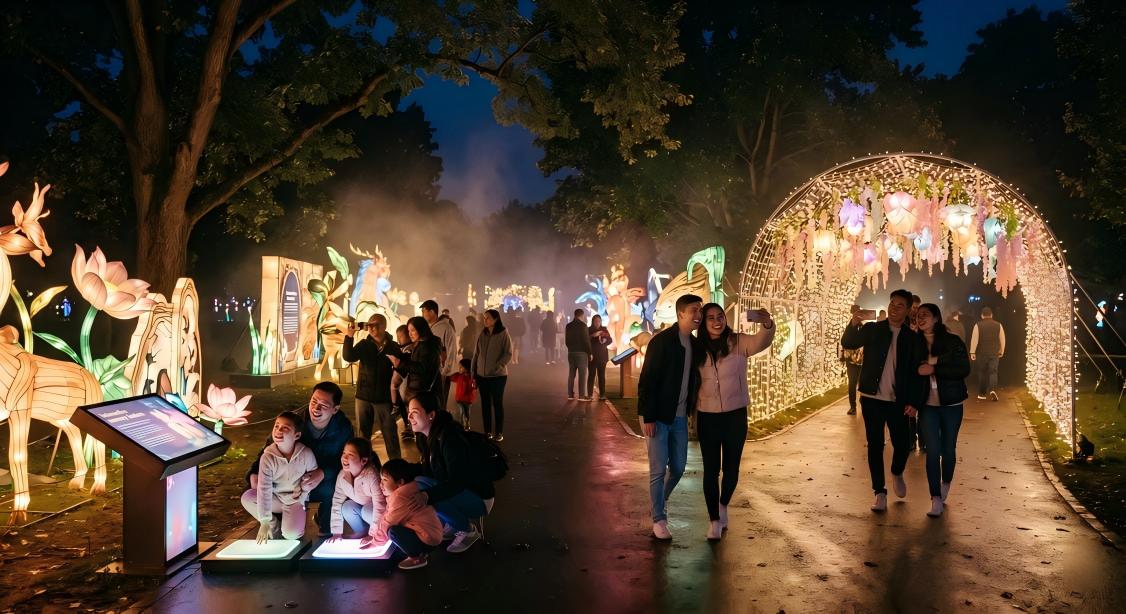
A successful park light show is never just about making a venue brighter. For parks, scenic areas, zoos, resorts, and outdoor attractions, the real question is: why do some light shows make visitors stay longer, take photos, share online, and spend more inside the venue, while others are quickly forgotten after a short walk?
The answer is not only found in the number of lights, the size of the displays, or the brightness of the installation. A high-ROI park light show is built around visitor psychology, route planning, emotional design, photo behavior, and commercial conversion.
At HOYECHI, we believe a strong night tourism light show should guide how visitors move, feel, interact, photograph, and remember the experience. When these details are planned correctly, a light show can become more than a visual attraction. It can become a powerful nighttime revenue engine for the venue.
The Real Goal of a Park Light Show
The goal is not simply to let visitors “see lights.” The real goal is to create moments that make visitors stop, smile, take photos, walk deeper into the venue, stay longer, and feel that the ticket was worth it.
Why Visitor Psychology Matters in Park Light Show Planning
Many light show projects fail because they are planned from the product side instead of the visitor side. The organizer may focus on how many displays are installed, how large each sculpture is, or how bright the area looks from a distance. But visitors judge the event differently.
Visitors care about whether the route feels interesting, whether they can take beautiful photos, whether their children feel excited, whether the atmosphere feels safe, and whether there are enough reasons to keep walking instead of leaving early.
This is why light show planning should begin with one question: what do we want visitors to do at each stage of the journey?
01. Stop
A strong visual scene should make visitors pause naturally and feel that the experience has started.
02. Explore
Lighting should guide visitors forward and create curiosity about what comes next.
03. Photograph
Photo-friendly scenes help visitors create social content and promote the venue for free.
04. Consume
A well-planned route can guide visitors toward food, retail, souvenirs, or activity zones.
01 The “Hero Shot” Strategy: Designing Photo Spots That Convert
In the social media era, visitors are not only audiences. They are also content creators. A family, a couple, or a group of friends may decide whether an event feels “worth visiting” based on the photos they can take there.
This is why a high-quality scenic area light show should include several intentional “Hero Shot” locations. These are not random decorations. They are carefully designed photo scenes where visitors can easily capture a beautiful image, even without professional photography skills.
What Visitors Want
Visitors want visual proof that they attended a special event. A strong photo spot helps them show that they had a meaningful, beautiful, and shareable experience.
What Parks Gain
Every shared photo becomes a trusted recommendation. It can reach local families, friends, and nearby communities more naturally than traditional advertising.
How to Create Better Hero Shot Areas
- Use walk-through arches, tunnels, large sculptures, or themed lantern groups as natural photo frames.
- Leave enough space in front of the display so families and groups can take photos comfortably.
- Place major photo spots where visitor flow naturally slows down.
- Use depth, symmetry, or repeated lighting elements to make photos look more impressive.
- Avoid placing the best display in a cramped or poorly lit corner where people cannot photograph it easily.
A good Hero Shot does not only improve the visual quality of the event. It improves marketing value, visitor satisfaction, and the perceived value of the ticket.
02 Route Psychology: Why Visitor Flow Is More Important Than Display Quantity
Many venues believe that more displays automatically create a better light show. In reality, a scattered layout often weakens the experience. When visitors cannot understand where to go next, they may feel tired, confused, or less motivated to continue exploring.
At night, visitors naturally prefer clearer guidance. A linear route or loop-style route can help guests feel safer, move more smoothly, and discover scenes in a planned order. This type of layout often creates a stronger sense of journey than placing displays randomly across a large area.
Better Route Design Means Better Commercial Design
A well-designed route does not only improve the visitor experience. It can also guide visitors toward food stalls, merchandise areas, interactive activities, photo services, or other secondary consumption zones.
Practical Route Planning for a High-ROI Light Show
Entrance
Use a strong gateway or illuminated arch to set expectations immediately.
First Photo Zone
Place a family-friendly photo scene early to create excitement and social sharing.
Main Walking Path
Use lights to guide visitors forward and maintain curiosity along the route.
Commercial Zone
Place food, drinks, souvenirs, or games where visitors naturally slow down.
A good route should feel natural, not forced. Visitors should feel that they are discovering the next scene by themselves, while the design quietly guides their movement.
03 Emotional Lighting: How Color, Rhythm, and Atmosphere Affect Visitors
A park light show should not use the same lighting mood from beginning to end. Visitors need emotional changes during the journey. A calm entrance, an exciting main scene, a romantic photo area, and a playful family zone can create a richer and more memorable experience.
Color temperature, brightness, music rhythm, shadow, and movement all influence how visitors feel. When these elements are planned together, the light show becomes more immersive.
| Design Element | Visitor Psychology | Best Use in a Park Light Show |
|---|---|---|
| Warm Lighting | Creates comfort, safety, and welcome | Entrance areas, family zones, food areas |
| High-Saturation Colors | Creates excitement and strong visual memory | Main photo scenes and themed display zones |
| Rhythmic Lighting | Builds energy and keeps visitors engaged | Interactive zones and music-synchronized areas |
| Light and Shadow Contrast | Creates mystery and a sense of discovery | Forest paths, bridges, lakesides, and transition zones |
The purpose of emotional lighting is to avoid visual fatigue. If every scene feels equally bright and equally colorful, visitors may quickly lose interest. A better strategy is to create rhythm: quiet, bright, surprising, immersive, and memorable.
04 Interaction and Social Proof: Turning Visitors from Viewers into Participants
Traditional displays often tell visitors, “Do not touch.” Modern light shows should do the opposite. They should invite visitors to participate.
When visitors can step on an interactive floor, wave their hands to change lights, walk through a glowing tunnel, or activate a display together, they feel more involved. This sense of participation makes the experience more memorable and encourages people to stay longer.
Individual Interaction
Visitors trigger lighting changes through movement, touch, sound, or walking patterns. This creates personal surprise and emotional connection.
Group Interaction
Multiple visitors work together to activate a large installation. This creates social proof and attracts more people to stop and watch.
Interactive installations are especially valuable for families, children, couples, and groups. They make the light show feel less like a static exhibition and more like a shared experience.
05 Where ROI Really Comes From in a Night Tourism Light Show
The ROI of a light show does not only come from ticket sales. A well-planned night attraction can create multiple layers of commercial value.
| ROI Source | How Light Show Design Supports It | Business Value |
|---|---|---|
| Ticket Revenue | Creates a reason to visit the park after dark | Adds a new nighttime income stream |
| Food and Beverage | Guides visitors toward rest points and gathering areas | Increases spending during the visit |
| Retail and Souvenirs | Places shops near high-traffic route sections | Turns visitor flow into purchase opportunities |
| Social Media Exposure | Creates photogenic Hero Shot locations | Generates organic marketing and local awareness |
| Repeat Visits | Uses themes, interaction, and seasonal updates | Extends the commercial life of the attraction |
This is why parks should not treat a light show as a decoration purchase only. It should be treated as a visitor behavior design project and a nighttime business plan.
How HOYECHI Helps Parks Build Higher-ROI Light Shows
HOYECHI provides more than lighting products. We help parks, scenic areas, and outdoor venues think about the entire visitor journey, from the entrance impression to the final commercial conversion point.
Free Initial Design Ideas
We can provide initial layout suggestions based on your venue size, route, terrain, and target visitor group.
Visitor Route Planning
We help plan how visitors enter, move, stop, photograph, consume, and exit the light show.
Photo Spot Design
We recommend light displays and scene combinations that are suitable for family photos, social sharing, and event promotion.
Outdoor Project Support
We provide outdoor-ready displays, installation guidance, and technical support for seasonal park light show projects.
FAQ: Visitor Psychology and Park Light Show ROI
Why is visitor psychology important for a park light show?
Visitor psychology helps parks understand how people move, stop, take photos, interact, and make spending decisions during a night event. A light show designed around visitor behavior can create better engagement and stronger commercial results.
What is a Hero Shot in a light show?
A Hero Shot is a highly photogenic scene designed for visitors to take memorable photos. It may be a walk-through arch, a glowing tunnel, a large lantern sculpture, or a themed display that works well as a social media photo spot.
Is route planning more important than display quantity?
Yes. A clear and engaging route can make a smaller number of displays feel more complete and valuable. Poor route planning may cause visitors to miss key scenes or leave too early, even if many displays are installed.
How can a light show increase secondary spending?
By guiding visitors through food areas, retail zones, souvenir points, and interactive activities, a light show can turn visitor flow into additional revenue opportunities beyond ticket sales.
Can HOYECHI help design the visitor route?
Yes. HOYECHI can provide initial design suggestions, display recommendations, and visitor route planning ideas based on the venue layout, budget, terrain, and project goals.
Build a Park Light Show That Visitors Want to Share
A successful park light show is not only about brightness. It is about emotion, movement, photography, interaction, and business conversion.
If your park, scenic area, zoo, resort, or outdoor venue wants to create a high-ROI night tourism attraction, HOYECHI can help you plan a light show that is beautiful, practical, and visitor-focused.
Contact HOYECHI to start planning your next park light show.
Post time: May-23-2026


