

rushed testing, and no acceptance standard—leading to
rework, budget overruns, delays, and frequent failures after opening.This guide provides a practical 17-step checklist, organized as a supplier collaboration workflow—from requirements to acceptance—so your light festival/lantern festival/light show can
open on time, stay safe, and run reliably.Role clarity (do not mix them):
ParkLightShow is the project and content team supporting concept planning, coordination, and execution communication.
HOYECHI is the registered brand and manufacturing system delivering product fabrication and supply capability.
In this article, the voice is ParkLightShow, while HOYECHI is referenced only when discussing manufacturing and product delivery.
For a broader framework, you can also reference our foundational guide:
Park Lantern Festival Project Guide.
Step 1: Requirements Alignment (Day 1–3) — Make Scope Unambiguous
1) Use a written requirements brief (not verbal descriptions)
A proper brief should include:
- Site type: park, zoo, botanical garden, shopping plaza, city street, etc.
- Project goals: traffic, ticket revenue, brand exposure, night attraction upgrade, secondary spend
- Opening date: fixed or flexible
- Budget range: whether it includes shipping, installation, and maintenance
- Operating model: purchase, rental, revenue-share (if applicable)
- Interactivity needs: walk-through tunnels, photo vehicles visitors can enter, synchronized effects
ParkLightShow tip: Define the non-negotiables on day one (opening date, fire lane width, installation windows). These boundaries control everything later.
2) Confirm audience profile and peak demand
Identify your primary visitor groups:
- Families: longer dwell time, stronger secondary spend
- Couples/young adults: photo/UGC shareability
- Groups/tours: burst arrivals, faster pace
If your venue is a zoo or family destination, this reference can help you structure “high-traffic night attraction” thinking:
Panda Theme Lights for Zoo Night Attraction.
Also confirm peak timing (weekends, holidays, evening peak hours) and whether timed entry / capacity limits are needed.
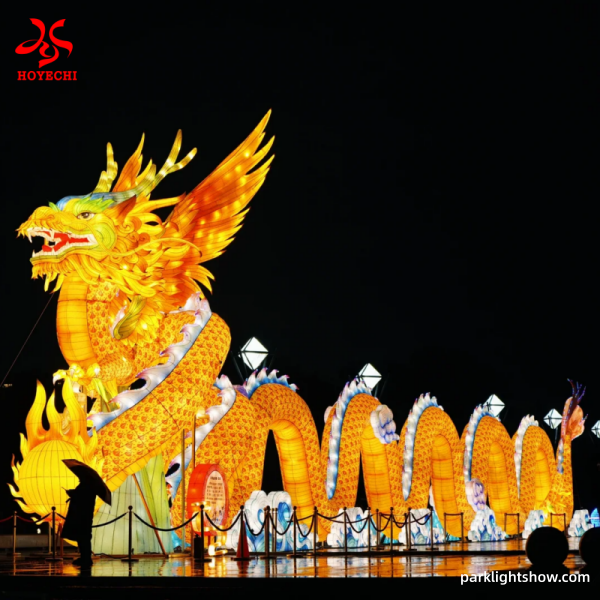
A signature dragon lantern centerpiece for lantern festivals, theme parks, and night tourism light shows.
Step 2: Site Data Collection (Day 3–7) — No Data, No Real Plan
3) Collect buildable site data (photos are not enough)
At minimum, gather:
- Site map with dimensions (or a measurable sketch)
- Elevation changes, slopes, stairs, bridges, trees/obstacles
- Entrances/exits and emergency access routes
- Existing power points and available capacity
- Vehicle access route for delivery and lifting/handling
ParkLightShow practice: Create one annotated “master site plan.” All design, pricing, and installation must reference this single version to prevent rework.
4) Confirm constraints early (these often create hidden costs)
- Is ground anchoring allowed (bolts/stakes), or only ballast weights?
- Is night installation allowed? What is the work window?
- Noise/light disturbance rules for nearby communities?
- Insurance requirements and third-party inspections?
Step 3: Visitor Flow and Zoning (Week 2) — Flow First, Visuals Second
5) Prioritize a one-way loop path when possible
A one-way loop reduces cross-traffic and bottlenecks, and creates a clear story rhythm:
- Entry build-up
- Peak feature zone
- Exit recovery + food/retail zone
If you want a real-world example of an experience designed for repeat visitation and long-term operation, see:
Inside Sensorio: Large-Scale Light Festival Design.
6) Build photo points with layers (not just “more pieces”)
A reliable mix:
- Landmark icons (1–2): memory + marketing
- Interactive features (3–6): dwell time + repeat visits
- Atmosphere pieces: continuous immersion
Don’t forget release zones (open areas) to absorb photo stops without blocking the walkway.
Step 4: 3D Concept + Itemized List (Week 2–3) — Make It Quotable and Buildable
7) Tie every 3D render to an itemized list with location IDs
Require a “single source of truth” that includes:
- Unique IDs (A01, A02, B01…)
- Size, materials, estimated power
- Installation method and footprint
- Site-plan location reference
This prevents the classic failure: “It’s in the render but not in the BOQ.”
For a deeper explanation of how to move from concept to signature installations, reference:
Design Customization Explained.
8) Treat walk-in / enterable features as a separate safety module
For photo vehicles visitors enter, walk-through tunnels, platforms:
- Load and guarding (handrails, pinch-point prevention, rounded edges)
- Anti-slip and drainage
- Doorway width and crowd control plan
- Night signage + supplemental lighting for safety
Step 5: Quotation + Contract Boundaries (Week 3) — Avoid Pricing Traps
9) Require an itemized quotation by modules
A professional breakdown should separate:
- Light sculptures / lantern installations fabrication
- Steel structure + foundation (anchors/ballast)
- Power distribution (cables, boxes, protection, grounding)
- Control system (timers, music sync, DMX if used)
- Shipping + handling
- Installation + commissioning
- Maintenance + spare parts
- Operational support (training / on-site engineer if needed)
Key rule: If it’s not a line item, it becomes a dispute later.
If you’re planning a large footprint (e.g., 10,000㎡+), this budgeting reference is useful for aligning stakeholders early:
10,000sqm+ Park Lantern Festival Cost & ROI (Buyout Model).
10) Lock change-order rules in writing
Define clearly:
- Design freeze date (after which sizes/quantities/structures do not change)
- How changes are priced (materials, labor, schedule impact)
- On-site change authority (who can approve and who pays)
Step 6: Sampling + Color Standards (Week 4) — Solve Disputes Before the Site
11) Sample or detail-confirm the critical pieces
Strong candidates for sampling:
- Landmark icons (your marketing centerpiece)
- High-interaction installations (wear-and-tear risk)
- Special finishes (gradients, reflective surfaces, custom textures)
12) Standardize color temperature and brightness
Confirm:
- Lighting palette (warm white, cool white, RGB, theme colors)
- Brightness hierarchy (icons brighter, atmosphere softer)
- Photo-friendliness (avoid harsh glare and face shadows)
HOYECHI note (manufacturing context only): At this stage, lock material/finish standards, connector specs, and packaging logic so production matches the approved visual and safety requirements.
Step 7: Mass Production + Packing Logic (Week 5–8) — Labeling Is Execution
13) Pack by “Zone + ID” so the site installs fast
Each crate/carton label should include:
- Zone: Zone A / Zone B
- ID: A01 / B03
- Carton count: 1/5, 2/5…
- Weight + dimensions
- Fragile notes + recommended unpack order
14) Define a spare parts plan before shipping
Typical spares:
- Connectors, extension cables, sealing rings
- Common LED strings / controller modules
- Power supplies and protection devices
- Fasteners + a quick-repair tool kit
Result: When issues happen, you fix them in minutes—not days.
Step 8: On-Site Installation + Programming (Week 8–10) — “Install Then Verify” Every Day
15) Break the daily plan into deliverable stages
For each zone:
- Unload → assemble → power-on test → cable fixing → waterproof sealing → night check
- Daily record: photos + ID list + issue log
16) Electrical safety and waterproofing are non-negotiable
On site, ensure:
- Protection devices tested and functioning
- Cables fixed, protected at crossings (anti-trip / anti-crush)
- Waterproof connectors sealed correctly
- Key equipment elevated above ground to avoid pooling water
If your project is seasonal (especially Q4), you may also want to benchmark how operators plan installations and visitor flow for holiday seasons:
Christmas Light Show Project Guide.
Step 9: Acceptance + Soft Opening + Maintenance (3–7 Days Before Opening) — No Standard, No Acceptance
17) Use three layers of acceptance plus a soft-opening buffer
A) Structure and public safety (daytime)
- Stability, no sharp edges, clear emergency routes, visible exit signage
B) Electrical and waterproofing (daytime + nighttime)
- Protection tests, grounding checks, cable management, connector sealing
C) Visual and operations (nighttime)
- Dark spots, glare, photo results, queue flow, wayfinding clarity
Soft opening: Reserve at least 1–3 days to simulate guest flow, identify bottlenecks, and fix faults before the real launch.
ParkLightShow Closing Checklist Summary (Copy/Paste Ready)
If you only remember one workflow, make it this:
Requirements brief → site data → flow zoning → 3D + itemized BOQ → modular quotation → sampling & standards → production & labeling → installation & programming → layered acceptance → maintenance plan.
To learn why our team structures projects this way, see:
Why ParkLightShow.
If you’d like a free initial concept direction + itemized BOQ structure from the ParkLightShow team, contact us here:
Get a Free Concept & BOQ.
Post time: Mar-01-2026


