

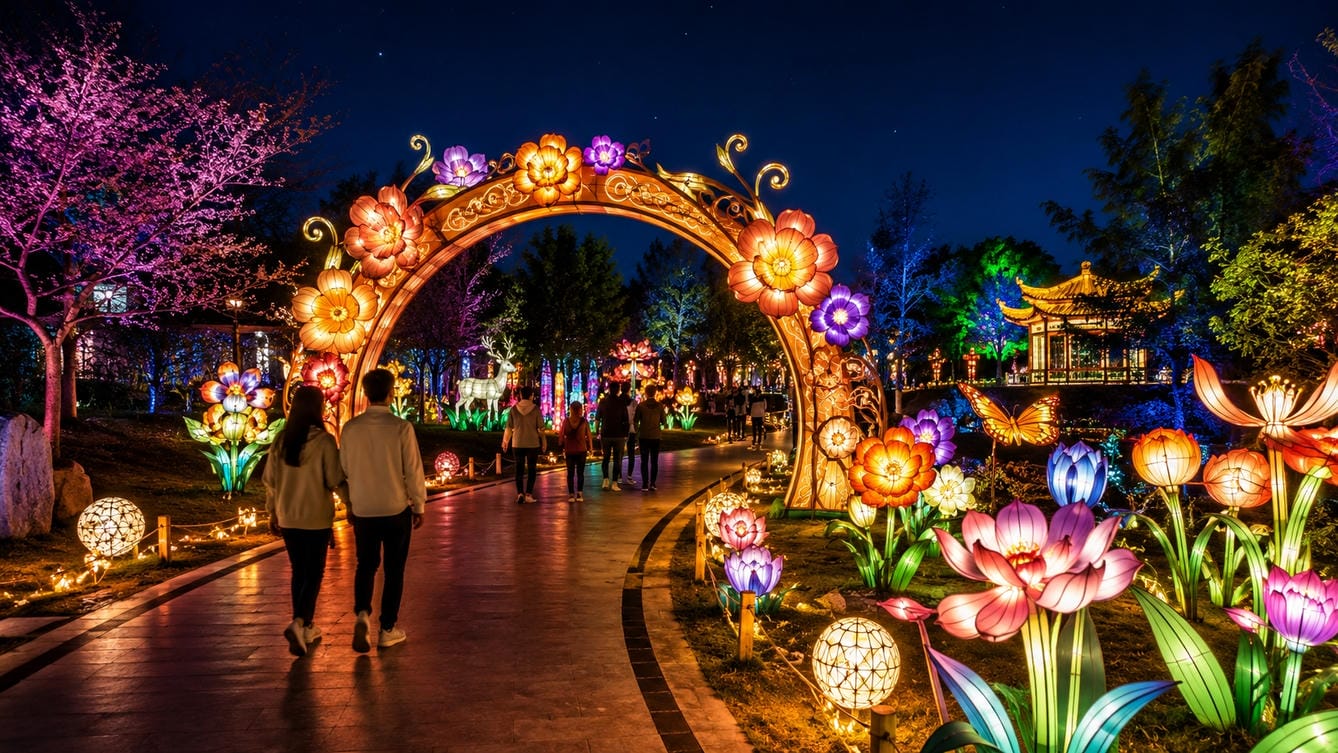
Many parks want to build a beautiful nighttime attraction, but they also worry about cost. A high-quality park light show can attract visitors, create photo opportunities, and increase nighttime revenue. However, if every display is fully customized, difficult to transport, and only used for one season, the total cost can become too high for many venues.
At HOYECHI, we believe a cost-effective light show should not be achieved by lowering quality. The smarter solution is to improve the design system behind the project. Through standardized production, creative lantern combinations, modular structures, reusable core equipment, and multi-venue rotation strategies, parks can build a light show that looks impressive while keeping long-term costs under control.
High Cost-Effectiveness Is a Design Result, Not a Low-Price Result
A truly cost-effective park light show is not built by choosing the cheapest products. It is built by designing every display, structure, lighting system, and operation model to create more value over multiple seasons.
Why Many Light Show Projects Become Expensive
A light show project can become expensive for several reasons. Sometimes the display designs are too difficult to manufacture. Sometimes the structures are too large to ship efficiently. Sometimes every item is made as a one-time custom piece. Sometimes low-quality components create high maintenance costs later.
These hidden costs are often ignored during the early planning stage. A display may look attractive in the drawing, but if it is difficult to produce, pack, ship, install, or reuse, the real project cost becomes much higher.
Expensive Production
Overly complex custom shapes increase labor, production difficulty, and manufacturing time.
High Shipping Volume
Large fixed structures take more container space and raise freight costs.
Short Service Life
Low-quality parts may reduce the first purchase price but increase future maintenance and replacement costs.
No Reuse Plan
If displays cannot be reused, rotated, or upgraded, the cost pressure returns every season.
01 Use Standardized Light Displays as the Project Foundation
Standardization is one of the most important ways to reduce cost without reducing quality. This does not mean every park light show should look the same. It means using reliable, repeatable display structures as the foundation, then changing the theme, layout, colors, and scene combinations to create a unique visitor experience.
For example, arches, tunnels, animal light sculptures, flower lanterns, tree lighting elements, star motifs, moon displays, and small interactive installations can be produced with standardized structures. These items are easier to manufacture, test, package, install, and reuse.
When these standardized light displays are placed through professional light show planning, they can create a rich and customized visitor experience without the cost of fully custom manufacturing for every element.
Design Principle
Standardized production controls cost. Creative scene combination creates uniqueness. The value comes from how the displays are used, not only from how many custom items are made.
02 Use Creative Lantern Design to Make Standard Displays Feel Fresh
A park light show should not feel like a warehouse of repeated products. Even when standardized displays are used, creative lantern design can make the experience feel artistic, seasonal, and site-specific.
The key is to combine standard lighting products with creative visual themes. A flower arch can become a romantic garden entrance. A group of animal lanterns can become a family-friendly discovery trail. A tunnel light can become a transition from one themed area to another. A simple moon or butterfly display can become a strong photo spot when placed in the right location.
This method allows parks to create different themes in different seasons while still using many of the same basic display assets.
03 Use Modular and Detachable Structures to Reduce Freight Costs
Freight is often a major cost in outdoor light show projects. Large decorative structures may look impressive, but if they cannot be disassembled, they can take up too much container space and increase shipping costs dramatically.
HOYECHI often recommends modular and detachable structures for large light displays. When arches, tunnels, trees, sculptures, and lantern frames are designed in sections, they can be packed more efficiently and transported at a lower cost.
A detachable structure also makes storage and future reuse easier. After the event season ends, the venue can disassemble the displays, store them more efficiently, and reinstall them in a new layout the next season.
Lower Shipping Volume
Detachable parts reduce wasted container space and help control freight costs.
Easier Installation
Modular sections can be assembled more efficiently on site with clear installation guidance.
Better Storage
Disassembled displays require less warehouse space after the season ends.
Flexible Reuse
Modular displays can be rearranged into new routes or themes for future events.
04 Invest in Quality Core Equipment for Long-Term Cost Reduction
Cost control does not mean every part of the light show should be made as cheaply as possible. In fact, the most important foundation equipment should be reliable, durable, and suitable for repeated outdoor use.
Stronger frames, better waterproof connectors, stable LED systems, reliable power distribution, and safer installation materials may increase the initial cost slightly, but they can reduce failures, maintenance, replacement, and emergency repair costs over multiple seasons.
For parks that plan to operate light shows every year, durable basic equipment is not an expense. It is an asset.
When quality equipment is used for multiple seasons, the cost of each season becomes lower. This is an important part of true cost-effectiveness.
05 Build a Reusable Asset System Instead of a One-Time Event
A smart park light show should not be designed as a one-time decoration purchase. It should be designed as a reusable asset system.
If the displays can be reused, rearranged, partially upgraded, and combined with new themes, the park does not need to rebuild everything from zero every year. Instead, the venue can keep the basic assets and update the story, route, and highlight scenes.
For example, a flower arch used at the entrance in the first year may become a photo zone in the second year. A light tunnel used along the main path may be moved near the commercial area. Animal lanterns may be regrouped into a children’s discovery trail. Tree lighting can be expanded gradually over multiple seasons.
Reusable Design Thinking
The first year should not only answer “How does the event look?” It should also answer “How can these assets be reused, rotated, and upgraded next year?”
06 Reduce Update Costs Through Multi-Park Rotation
One of the biggest challenges for recurring light shows is freshness. Visitors may not want to see the exact same displays every year. However, replacing all displays every season can be expensive.
A smarter solution is multi-venue rotation. If several parks, scenic areas, or partner venues operate light shows within the same network, they can rotate selected display groups between locations. This allows each venue to refresh part of the visitor experience without purchasing a completely new set of displays every year.
For example, Park A may use a butterfly theme in the first season and exchange part of its display set with Park B’s animal theme in the second season. Park C may receive a tunnel and flower display combination while sending its moon and star displays to another site. With careful planning, each park gets a fresh visitor experience while the overall asset cost is shared across multiple venues.
This model is especially useful for park groups, tourism companies, event operators, municipal partners, and organizations that manage multiple outdoor venues. It can also support deeper venue partnership for light festivals when several locations want to develop night tourism together.
How HOYECHI Supports High-Quality and Cost-Effective Park Light Shows
HOYECHI helps clients think beyond the first purchase. We support parks and scenic areas in building light show systems that are visually attractive, operationally practical, and suitable for long-term use.
Whether the project is a park, resort, zoo, farm, tourism destination, or scenic area light show, the planning should consider not only the first-season visual effect, but also freight, installation, storage, reuse, update cost, and long-term visitor experience.
Standardized Production
We recommend suitable standard display structures to reduce production cost and improve reliability.
Creative Lantern Design
We combine standard displays with creative themes, colors, and layout ideas to make each project feel unique.
Modular Structures
We design detachable structures when suitable to reduce shipping volume, storage pressure, and installation difficulty.
Long-Term Asset Planning
We help venues consider reuse, rotation, upgrade, and seasonal refresh strategies from the beginning.
FAQ: High-Quality and Cost-Effective Park Light Show Design
Can a standardized light display still look creative?
Yes. Standardized displays can look very different when they are used with different themes, color combinations, routes, landscapes, and scene arrangements. Creativity comes from the full design system, not only from custom manufacturing.
Why are modular structures important for park light shows?
Modular and detachable structures can reduce shipping volume, make installation easier, lower storage pressure, and allow the displays to be reused or rearranged in future seasons.
Does high quality increase the project cost?
Good quality may increase the initial cost slightly, but it can reduce maintenance, replacement, and failure costs over multiple seasons. For recurring park light shows, reliable equipment often lowers the long-term cost.
How can parks reduce the cost of updating a light show every year?
Parks can reuse core displays, change scene layouts, add a few new highlight pieces, and rotate display groups with other venues if they operate in a multi-park network.
Can HOYECHI help plan a reusable light show system?
Yes. HOYECHI can provide initial design suggestions, product matching, modular structure recommendations, and long-term reuse ideas based on the venue’s budget, layout, and operation plan.
Build a Light Show That Looks Better and Costs Smarter
A high-quality park light show does not have to depend on unlimited investment. With standardized production, creative lantern design, detachable structures, durable equipment, and long-term asset planning, parks can create impressive nighttime attractions while controlling total cost.
If your park, scenic area, resort, or outdoor venue wants to build a cost-effective light show system, HOYECHI can help you plan a solution that balances visual impact, operational quality, and long-term value.
Contact HOYECHI to start planning your high-quality, cost-effective park light show.
Post time: May-26-2026


