

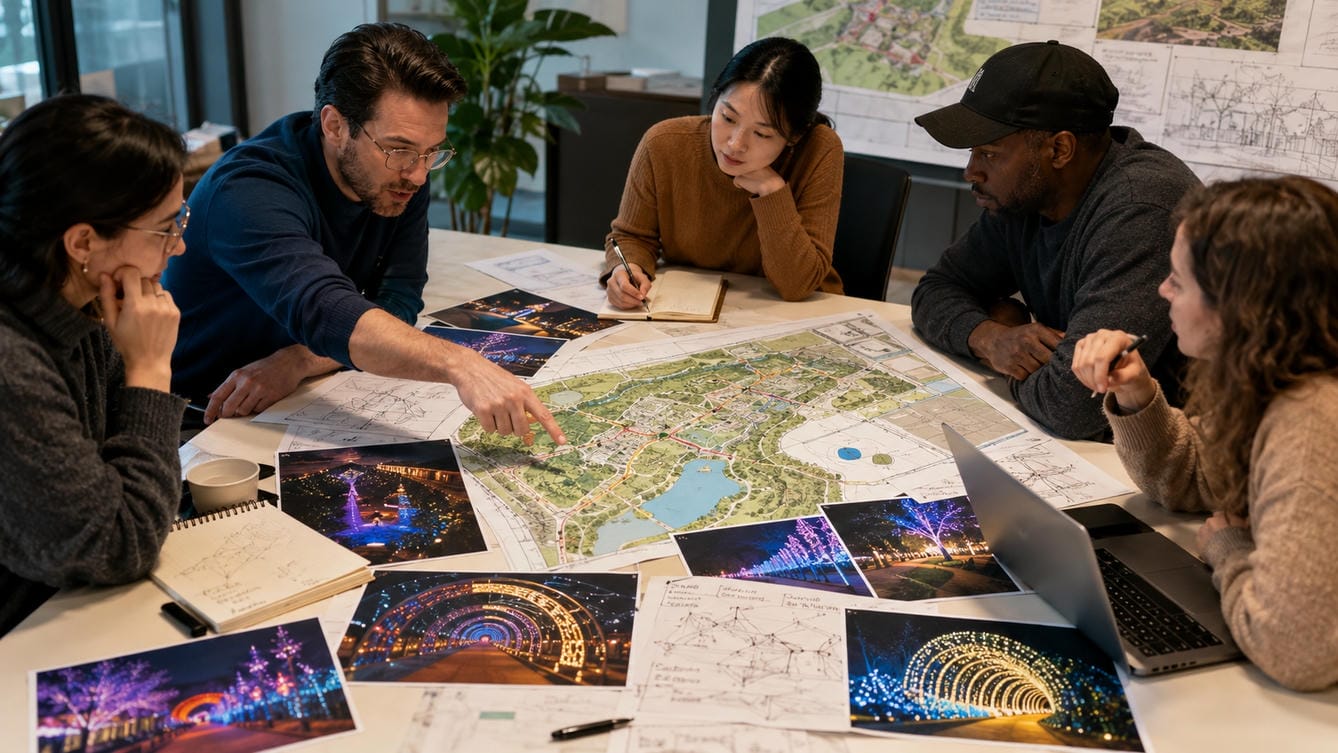
Planning a first night tourism light show is exciting, but it can also be risky. Many parks, scenic areas, farms, resorts, and outdoor venues want to attract visitors after dark, create new ticket revenue, and turn quiet evening hours into a profitable experience.
However, a successful park light show is not simply about buying many illuminated displays and placing them across the venue. The biggest problems often happen before installation begins: poor route planning, unrealistic scale, weak photo spots, wrong commercial layout, and no long-term update plan.
For a venue planning its first night tourism light show, avoiding early mistakes is often more important than adding more lights. A well-planned first project can help the venue test visitor demand, reduce investment risk, and build a foundation for future seasonal events.
The First Light Show Should Be a Smart Beginning, Not a Costly Experiment
The goal of a first light show is not to build the largest event possible. The goal is to create a complete visitor experience, control risk, and learn what works for the venue’s market.
Why First-Time Light Show Projects Often Struggle
Many first-time projects fail not because the displays are unattractive, but because the event is planned from the product side instead of the visitor side. The venue focuses on how many lights to buy, but not enough on how visitors will enter, move, stop, take photos, consume, and leave.
A light show is not only a visual project. It is also a visitor route project, a nighttime operation project, and a commercial layout project. When these parts are ignored, even a large investment may not produce strong results.
Too Much Area
The venue tries to decorate too large an area, making the event feel empty and difficult to manage.
Weak Route Design
Visitors are not guided naturally, so they may miss key scenes or leave before seeing the full experience.
No Clear Photo Moments
Displays look nice on site, but they do not create strong photo-sharing opportunities.
No Second-Year Plan
The venue completes one season but does not know how to refresh, reuse, or expand the project later.
01 Mistake: Starting with a Project That Is Too Large
One of the most common mistakes is trying to cover too much space in the first season. A large map may look impressive in planning, but if the budget is spread too thinly, the actual visitor experience can feel weak.
For a first-time light show, a smaller but complete route is often better than a large but empty layout. Visitors should feel that they are moving through a clear nighttime journey, not walking between scattered displays with dark gaps in between.
Better Approach
Start with a focused route that includes an entrance scene, several strong display zones, a main photo point, and a natural exit or commercial area. Expand the project after the first season proves visitor demand.
02 Mistake: Buying Displays Before Planning the Visitor Route
A light show should not begin with a shopping list. It should begin with light show planning: where visitors enter, how they move, where they stop, what they photograph, and where they spend money.
If displays are purchased first and the route is planned later, the venue may end up with beautiful products that do not work together as one experience.
03 Mistake: Focusing Only on Display Quantity
More displays do not always create a better event. If the light show has no visual rhythm, no clear theme, and no strong highlight, visitors may feel that everything looks similar after a short time.
A better strategy is to create layers. Some displays should welcome visitors. Some should guide movement. Some should create photo opportunities. Some should support family interaction. Some should improve the atmosphere near food or retail areas.
Entrance Layer
Creates the first impression and makes visitors feel they have entered a special event.
Route Layer
Uses arches, tunnels, and path lighting to guide visitors naturally through the venue.
Photo Layer
Creates strong visual scenes that visitors want to photograph and share.
Commercial Layer
Builds atmosphere near food, retail, souvenirs, and activity zones.
04 Mistake: Not Designing Strong Photo Spots
In a modern night tourism event, visitors are not only viewers. They are also promoters. If the light show gives them beautiful photos, they may share the experience with family, friends, and local communities.
Many first-time projects install attractive displays but forget to create enough space for photography. A beautiful sculpture placed in a narrow corner may look good on site but perform poorly as a photo spot.
A Good Photo Spot Should Have:
- A clear visual subject, such as an arch, tunnel, large lantern, or sculpture
- Enough standing space for families and groups
- A good viewing angle from the visitor route
- Safe lighting around the ground and walking area
- A natural place in the route where visitors slow down
05 Mistake: Ignoring Power, Waterproofing, Installation, and Maintenance
A park light show is an outdoor project. It must handle weather, installation safety, power distribution, cable layout, ground conditions, storage, and maintenance.
Some venues focus mainly on visual effect during the planning stage, but ignore the technical foundation. This can create problems during operation, especially in rainy, windy, or high-traffic environments.
06 Mistake: Putting Food, Retail, and Activity Areas in the Wrong Places
A light show can support more than ticket revenue. It can increase food sales, souvenirs, games, photo services, and family activities. But this only works when commercial areas are placed in the right locations.
If food stalls or retail areas are placed far away from the visitor route, many guests may never reach them. If they are placed too early, visitors may pass them before they are ready to stop. If they are placed near natural rest points, photo areas, or route intersections, they can perform much better.
For a first-time project, the venue should consider the light show business plan together with the route design, not after the lighting layout has already been fixed.
Commercial Layout Tip
Place food, retail, and activity zones where visitors naturally slow down: after a major photo spot, near the middle of the route, beside a rest area, or close to the final highlight scene.
07 Mistake: Not Planning for the Second Season
Many parks focus only on opening the first season, but do not think about what happens next year. This can create a serious problem: visitors may not want to see exactly the same event again.
A smart first light show should leave room for future updates. Displays should be reusable when possible. Routes should be adjustable. Some standard structures can be moved to new positions. A few new highlight pieces can be added each season to refresh the experience.
This is especially important for a scenic area light show, because the project often needs to operate across multiple seasons and maintain local visitor interest.
Reusable Displays
Choose structures that can be stored, repaired, moved, and used again in future seasons.
Flexible Routes
Avoid designing every scene as fixed forever. Leave room for route changes and scene updates.
Seasonal Refresh
Add several new highlights each year instead of replacing the entire project.
Visitor Feedback
Use the first season to learn which scenes, routes, and activities visitors enjoy most.
Summary: First Light Show Planning Mistakes and Better Solutions
How HOYECHI Helps Parks Avoid These Mistakes
HOYECHI helps parks and outdoor venues think beyond individual light displays. We support clients in planning the full project experience, including entrance impression, visitor route, photo spots, display selection, technical installation, commercial layout, and future updates.
For first-time night tourism projects, this planning support can help reduce trial-and-error costs and make the first season more practical, attractive, and easier to expand.
Initial Design Suggestions
We help evaluate the venue layout, entrance, walking route, and suitable light show scale.
Product Matching
We recommend suitable arches, lanterns, tunnels, sculptures, and landscape lighting for the route.
Outdoor Project Experience
We consider installation, weather, power, transport, storage, and future reuse.
Long-Term Planning
We help venues plan not only the first season, but also future upgrades and seasonal refreshes.
FAQ: First Night Tourism Light Show Planning
What is the biggest mistake parks make when planning their first light show?
The biggest mistake is often planning the project around products instead of visitors. A successful light show should begin with visitor route, photo spots, commercial layout, and operation needs.
Should a first park light show cover the entire venue?
Not always. For many first-time projects, a focused and complete route is better than decorating a very large area with weak visual density.
How many photo spots should a first light show include?
The number depends on the venue size and route length, but a first project should include several strong photo moments rather than many scattered decorations.
Why is power planning important for outdoor light shows?
Power planning affects safety, stable operation, installation cost, and maintenance. It should be considered before final display locations are confirmed.
Can HOYECHI help with early-stage planning?
Yes. HOYECHI can provide initial design suggestions, product recommendations, route planning ideas, and technical support based on the venue’s layout and project goals.
Plan Your First Light Show with Fewer Mistakes
A first night tourism light show should not be a costly experiment. With the right planning, parks can create a visitor-friendly, commercially practical, and expandable nighttime attraction.
If your park, scenic area, farm, resort, or outdoor venue is preparing for its first light show, HOYECHI can help you avoid common planning mistakes and build a stronger foundation from the beginning.
Contact HOYECHI to start planning your first park light show.
Post time: May-27-2026


