

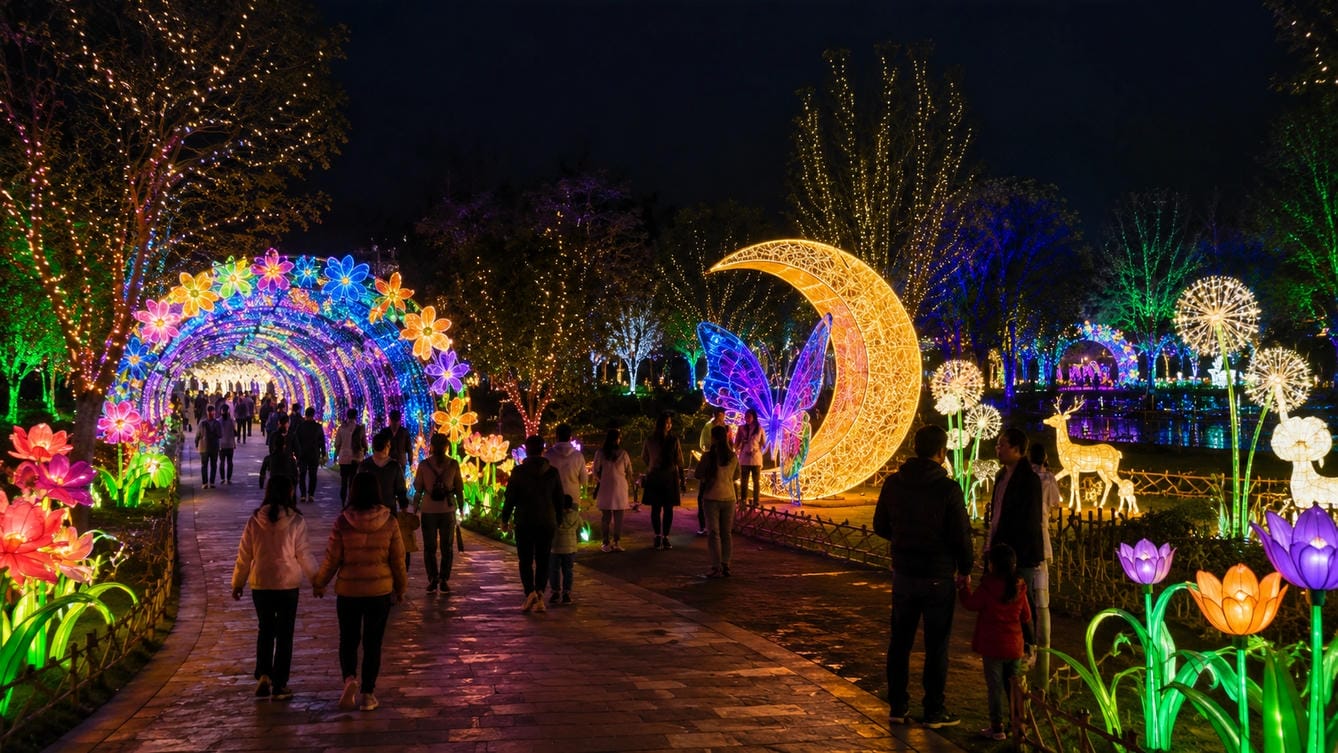
Many new parks, scenic areas, farms, resorts, and outdoor entertainment venues face the same difficult problem: if they invest heavily in a large-scale light show before the market is tested, the financial risk can be high. But if they do not invest at all, the venue may continue to struggle with low nighttime traffic.
This is a common challenge for new or developing venues, especially those located in areas with a smaller surrounding population, limited tourism traffic, or uncertain seasonal demand. They need a nighttime attraction to bring people in, but they also need to control investment risk.
At HOYECHI, we believe the answer is not to choose between “big investment” and “no investment.” The better solution is to build a cost-effective light show with smart design, suitable lighting combinations, and a phased development strategy.
Cost-Effective Does Not Mean Low Quality
A cost-effective light show is not a cheap-looking light show. It means using the right products in the right places, avoiding unnecessary spending, and turning a limited budget into a complete visitor experience.
The Dilemma of New Venues: Spend Too Much or Stay Invisible?
A mature destination may already have strong brand awareness, regular visitor traffic, and proven ticket revenue. But a new venue usually does not have these advantages at the beginning.
If the venue invests too much too early, it may face a long payback period. If the event fails to attract enough visitors in the first season, the pressure can become serious. On the other hand, if the venue does nothing, it may remain unknown, especially at night.
This creates a difficult cycle:
No Night Attraction
Visitors have no strong reason to come after dark, so the venue loses evening traffic and potential revenue.
Low Visitor Awareness
Without a visible event or shareable experience, the venue struggles to attract attention from local families and tourists.
Limited Revenue
Low traffic makes it harder to support food, retail, activities, ticketing, or future upgrades.
Fear of Investment
Because revenue is uncertain, the venue becomes more hesitant to invest in new attractions.
A well-planned light show can help break this cycle. It gives the venue a reason to promote, a reason for visitors to come, and a first step toward building nighttime income.
01 Start with a “Right-Sized” Light Show, Not the Biggest One
For a new venue, the first light show should not be designed only to impress on paper. It should be designed to match the real market around the venue.
A park surrounded by a small local population does not need to copy the budget of a major city festival. A farm attraction, family park, or small scenic area may achieve better results by starting with a smaller but complete light show that can be tested, improved, and expanded later.
HOYECHI Planning Principle
The first-stage light show should be large enough to create a ticket-worthy experience, but controlled enough to avoid unnecessary financial pressure.
This approach allows the venue to test visitor response, collect feedback, understand peak visiting times, and identify which scenes are most popular before investing in a larger project.
02 Combine Different Types of Lights Instead of Relying on One Expensive Feature
Some venues make the mistake of spending most of the budget on one oversized custom display. While a large landmark can be powerful, it may not create a complete visitor journey by itself.
A more cost-effective strategy is to combine different types of light displays, each with a clear function in the visitor experience.
| Light Type | Best Use | Why It Is Cost-Effective |
|---|---|---|
| Entrance Arch | Creates a strong first impression | Gives visitors an immediate sense of arrival without decorating the whole park |
| Walk-Through Tunnel | Guides movement and creates photo moments | Combines route guidance, interaction, and social sharing in one display |
| Standard Light Sculptures | Builds themed scenes along the route | Reusable, easier to install, and more budget-friendly than fully custom pieces |
| Tree and Landscape Lighting | Uses existing natural features | Expands the visual atmosphere without adding many large structures |
| Interactive Small Displays | Creates family engagement | Increases play value and dwell time without requiring a huge display footprint |
The goal is to let every display play a role. Some lights attract attention. Some guide the route. Some create photos. Some support family interaction. Some improve the atmosphere of commercial areas.
03 Use Design to Make a Smaller Project Feel Complete
A light show does not feel valuable because it covers every square meter of the venue. It feels valuable when visitors experience a clear beginning, development, highlight, and ending.
Even with a controlled budget, a venue can create a complete feeling by arranging scenes in a logical order.
Beginning
A strong entrance arch or welcome scene tells visitors they have entered a special nighttime event.
Route
A clear walking path connects different scenes and keeps visitors moving naturally.
Highlight
One or two strong photo scenes become the main memory points of the light show.
Ending
A final scene near food, retail, or exit areas helps convert visitor flow into business value.
This is where professional planning matters. A poorly planned project may feel empty even with many displays. A well-planned project can feel rich and complete even with a more reasonable display quantity.
04 High Cost-Effectiveness Requires Quality, Not Cheap Materials
One important misunderstanding is that a cost-effective light show should use the cheapest possible products. This is dangerous for outdoor projects.
A low-quality display may look acceptable at the beginning, but it can create problems during operation: unstable lighting, poor waterproof performance, weak structures, color fading, difficult maintenance, and a shorter usable life.
For a park or scenic area, these problems do not only affect appearance. They can affect safety, visitor experience, maintenance cost, and the reputation of the venue.
| Cheap Project Thinking | Cost-Effective Project Thinking |
|---|---|
| Choose the lowest price only | Choose reliable products that match outdoor use and long-term operation |
| Buy many scattered decorations | Build fewer but stronger scenes with clear functions |
| Ignore route planning | Use lighting to guide visitors and extend stay time |
| Focus only on the first purchase cost | Consider reuse, storage, maintenance, installation, and future expansion |
A truly cost-effective light show should reduce waste, not reduce quality. It should help the venue spend wisely, operate safely, and reuse or upgrade the displays in future seasons.
05 Plan the First Season as a Test, Not a Final Version
For new venues, the first light show should be treated as a market test and brand-building opportunity. It does not need to be the final version of the venue’s night tourism project.
A smart first season should answer several key questions:
- Which visitor groups are most interested in the night event?
- Which photo spots are shared most often?
- Which route sections have the longest stay time?
- Where should food, retail, or activity areas be placed?
- What scenes should be upgraded or expanded next season?
This phased model is especially suitable for venues with uncertain local demand. Instead of risking a large budget at once, the venue can use the first season to prove the market and create a foundation for future growth.
A Better Development Path
Start with a focused and well-designed light show. Use the first season to attract visitors and collect feedback. Then expand the most successful areas in the second season.
What Kind of Venues Need This Cost-Effective Light Show Model?
This model is especially suitable for venues that want to build nighttime traffic but cannot take on the risk of a very large first investment.
New Parks
Need a visible attraction to build awareness and bring visitors after dark.
Small Scenic Areas
Need a night tourism product but must match investment with local visitor potential.
Family Farms
Can use light shows to extend operating hours and create seasonal family events.
Resorts and Campgrounds
Can improve guest experience and create evening activities without heavy construction.
How HOYECHI Helps Build a Cost-Effective Light Show
HOYECHI helps parks and outdoor venues create light shows that are not only attractive, but also practical for real operation.
Our team can help clients evaluate site conditions, visitor routes, budget range, display selection, installation needs, and future expansion possibilities. Instead of simply recommending more products, we focus on helping the venue build a balanced solution.
Free Initial Design Support
We can provide early layout suggestions based on the venue map, walking paths, entrance location, and project goal.
Smart Product Matching
We help combine arches, lanterns, sculptures, tree lighting, tunnels, and interactive displays according to budget and visitor flow.
Phased Project Planning
We help venues start with a controlled first-stage project and leave room for future upgrades.
Outdoor-Ready Manufacturing
We provide lighting displays designed for outdoor seasonal use, with attention to structure, waterproofing, installation, and reuse.
FAQ: Cost-Effective Light Shows for New Venues
Is a cost-effective light show the same as a cheap light show?
No. A cheap light show usually focuses only on reducing the purchase price. A cost-effective light show focuses on smart design, reliable products, better route planning, reuse value, and long-term operation.
Can a small venue build a light show without a large investment?
Yes. Many small and medium venues can start with a focused light show using standard displays, clear walking routes, and selected photo scenes. The key is to avoid spreading the budget too thinly across a large area.
Why should new venues avoid over-investing at the beginning?
New venues may not yet know their real nighttime visitor demand. Starting with a controlled first-stage project helps reduce risk while testing the market and building local awareness.
What types of lights are best for a cost-effective park light show?
Entrance arches, walk-through tunnels, standard lantern displays, light sculptures, tree lighting, and small interactive installations can be combined to create a strong experience within a reasonable budget.
Can HOYECHI provide design advice before production?
Yes. HOYECHI can provide initial design ideas and product recommendations based on the venue layout, project budget, target visitors, and long-term operation plan.
Build a Light Show That Matches Your Venue, Budget, and Market
If your venue needs a nighttime attraction but is not ready for a large first investment, HOYECHI can help you create a cost-effective light show plan.
With smart design, suitable lighting combinations, and phased planning, your park or scenic area can attract visitors after dark without taking unnecessary financial risk.
Contact HOYECHI to start planning a cost-effective light show for your venue.
Post time: May-25-2026


