

For many parks, zoos, resorts, city venues, and commercial districts, one of the most confusing parts of planning a light show is not whether to do it, but how to judge the quotations. Two proposals may look similar on paper. Both may include illuminated sculptures, themed scenes, walk-through elements, and visitor photo points. Yet one quote may be two or three times higher than the other.
This gap is rarely explained by “the lights” alone. In large-scale outdoor projects, the final budget is shaped by a much wider system: design intent, route density, structural safety, power distribution, shipping logic, installation constraints, maintenance expectations, and future reuse. That is why the real difference between quotations often comes from the parts that are least visible in a concept rendering.
If buyers compare only visuals and total price, they may misread the true value of a proposal. If they understand the hidden cost drivers behind execution, they are more likely to avoid budget overruns, change-order disputes, and long-term operational problems.
1. The Same Type of Project Can Have Very Different Cost Logic
Not every park light show is trying to achieve the same outcome. Some are short seasonal events designed to create immediate visitor traffic. Some are multi-season assets intended for storage, reuse, and gradual expansion. Others are experience-led night attractions where circulation, interaction, and dwell time matter as much as visual impact.
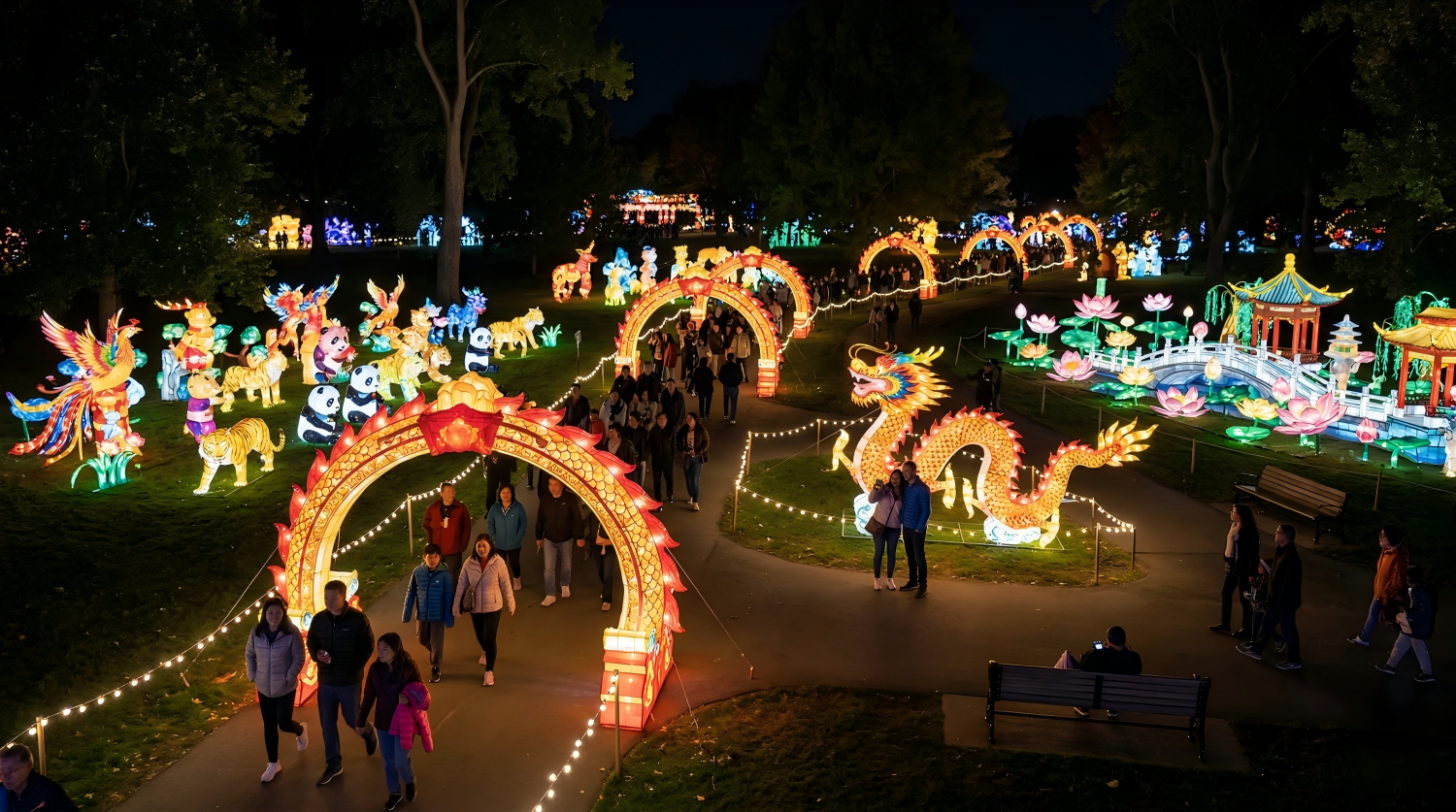
These strategic differences change the budget structure from the beginning. A short-run attraction may prioritize opening speed, hero scenes, and visual density at the entrance. A reuse-oriented project may spend more on structure, anti-corrosion treatment, modular fabrication, and packaging logic. A high-immersion event may allocate more resources to storytelling, programming, interactive nodes, and scene-to-scene transitions.
In other words, two proposals that appear similar may not be solving the same problem. One may be designed as a fast seasonal display, while the other is built as a repeatable operating asset. If the project goal is not clearly defined before comparison, even a detailed quotation can be misleading.
2. Experience Density Often Matters More Than Site Size
Buyers often begin by asking how much a light show costs per square meter. While site area matters, it does not explain the whole budget. In practice, what changes cost more dramatically is the amount of content placed inside that space.
Two 10,000-square-meter venues can feel completely different. One may contain a simple walking route with a few landmark installations and atmospheric lighting. The other may be divided into multiple themed zones with layered scenes, transitions, interactive points, and photo nodes throughout. The site size is the same, but the experience density is not.
That density affects design hours, fabrication complexity, power distribution, installation sequencing, maintenance load, and visitor behavior. It also affects whether the project feels like basic site decoration or a complete nighttime attraction.
If you are still refining route logic and visitor flow, it is useful to compare this topic with a more planning-focused framework in our park lantern show planning checklist.
3. Power and Cabling Are Often Underestimated Until the Site Stage
Concept visuals rarely reveal one of the most important budget factors: how the show will actually be powered. In large outdoor venues, electrical cost is not just about whether the installations light up. It includes load distribution, cable runs, control box locations, waterproofing, access for maintenance, protection measures, and the relationship between power points and route layout.
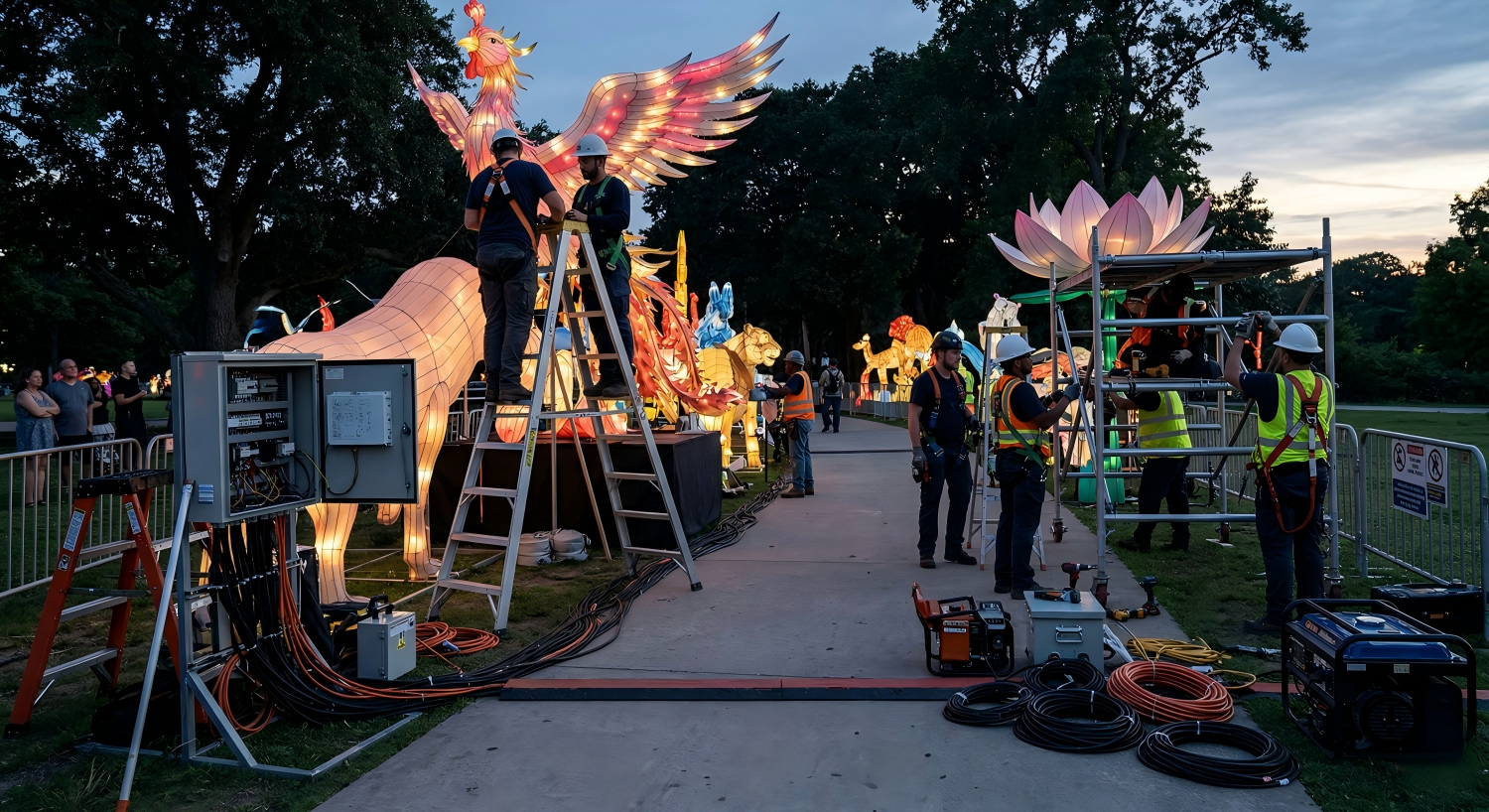
The farther the usable power source is from the display zones, the more likely the quotation will rise. Costs increase further when a project requires multiple zones, synchronized timing, interactive controls, or hidden cable routing that protects both safety and visual quality.
Low quotations sometimes seem attractive because these items are only partially included, loosely estimated, or deferred until site execution. Once real cabling, distribution boxes, protective routing, and commissioning are added, the apparent savings may disappear.
4. Structural Safety Is Not an Upgrade. It Is the Base Condition of Outdoor Work
For temporary indoor installations, appearance may dominate the discussion. For outdoor public projects, structure is part of the minimum requirement. A large illuminated sculpture or walk-through element must do more than look correct in a rendering. It must remain stable through transport, installation, weather exposure, repeated handling, and close visitor contact.
This is especially important for gateways, centerpiece structures, overhead elements, and any installation placed near active visitor circulation. In these cases, budget differences often reflect variations in steelwork, joint design, support method, surface treatment, anti-rust measures, and the logic of modular assembly.
These are not always the most visible parts of a project, but they are among the most difficult to repair later. Many low-cost proposals reduce price by simplifying the hidden structure first. Unfortunately, those hidden elements are also where long-term risk tends to accumulate.
5. Bigger Is Not Always More Expensive. More Difficult Usually Is
Scale does affect cost, but not in a simple linear way. In fabrication, a very large but geometrically straightforward piece may be easier to produce than a smaller installation with highly irregular curves, layered surfaces, custom finishing, mixed materials, and complex lighting effects.
Another hidden factor is variation. A project where each zone uses completely different shapes, visual language, and structure types often becomes more expensive than a project with strong thematic unity and controlled diversity. Standardization supports fabrication efficiency. Uncontrolled variety usually increases labor, testing, packaging complexity, and installation coordination.
The strongest projects do not make every piece equally complex. They create budget discipline by strengthening hero scenes, simplifying support scenes, and building visual rhythm across the route.
6. Shipping Cost Is Really About Packaging Logic and Modular Thinking
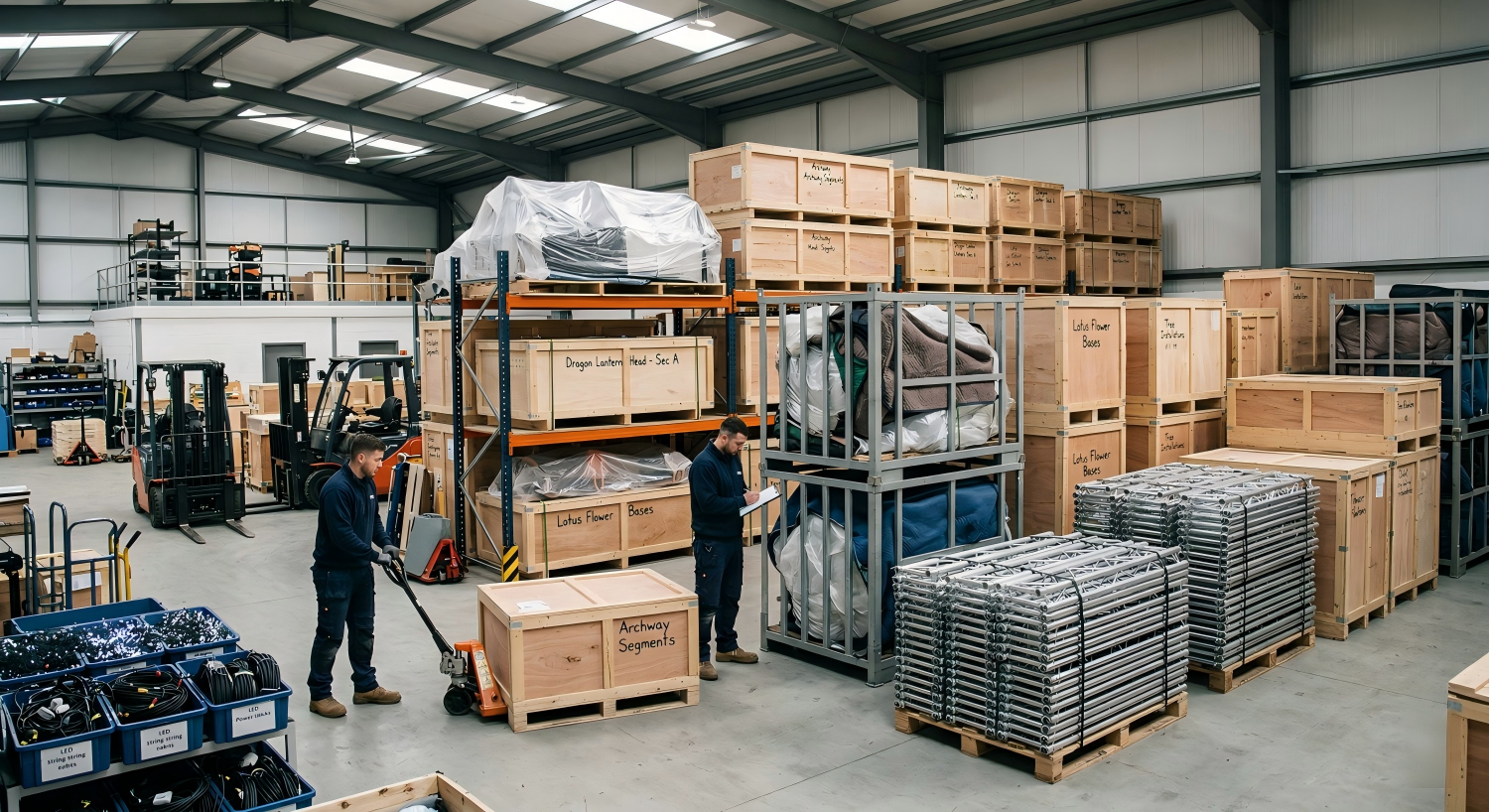
Many buyers look at shipping as a line-item freight question. In reality, transport cost begins much earlier, during design and engineering. If the installations are not designed for modular splitting, folding, standardized packing, and practical loading, the project may consume more container space, require more handling labor, and create a slower, riskier installation process on site.
By contrast, a quotation may be higher upfront because the fabrication method already accounts for transport efficiency. That can reduce volume, improve handling, shorten assembly time, and increase the likelihood of successful reuse.
This topic becomes even more important in international projects, long-distance trucking, seasonal takedown, and warehouse turnover. Shipping should never be evaluated as freight alone. It should be understood as the combined result of packaging design, structural segmentation, and installation logic.
7. Shorter Installation Windows Usually Push Site Costs Higher
Many public venues have tight access windows. Work may be restricted to nighttime hours, short pre-opening periods, or limited zones that must remain compatible with daytime operations. In these cases, installation cost is not only about the number of workers or the number of days. It is also about coordination intensity.
Compressed installation schedules require more disciplined sequencing: which materials arrive first, which zones must be completed before others, how electrical work interacts with structural work, and how testing happens without blocking later teams. A quotation that includes this coordination may look higher, but it may also represent lower execution risk.
If execution-stage control is a priority, a related reference is our 17-step execution checklist for light festival projects, which looks more closely at scope control, itemized quotation structure, and change-order prevention.
8. Interactivity and Control Systems Change the Budget Structure
A static visual route and an interactive visitor experience may look similar in promotional language, but they are not priced in the same way. The moment a project includes triggered lighting changes, music response, synchronized control, or participatory nodes, it begins to rely on a deeper technical layer.
That layer may include control programming, testing, wiring logic, commissioning time, fault diagnosis, and maintenance support after opening. Interactivity can add strong visitor value, but it can also introduce long-term operational demands if it is not matched to the venue’s staffing model, route behavior, and maintenance capacity.
For this reason, interactive features should not be added simply because they sound impressive. They should be chosen only when they support the project’s real audience behavior and operating conditions.
9. Reuse Is Not Something You Decide After the Season Ends
Many project owners say they want a light show that can be reused. In practice, reuse is not achieved simply by storing the installations after closing. It depends on whether the system was designed for repeated disassembly, packing, transport, storage, repair, and future reconfiguration from the very beginning.
A genuinely reusable project usually has clearer modular division, stronger connection logic, more durable surface treatment, traceable packaging, replaceable wear parts, and a practical strategy for combining old and new content in future seasons.
Without those conditions, reuse may be technically possible but operationally inefficient. The installations may survive, but the labor, refurbishment, and storage burden may erode most of the economic advantage.
10. The Most Dangerous Quote Is Not Always the Highest. It Is Often the Least Clear
One of the most common causes of project frustration is not an expensive quotation. It is a vague one. If a proposal gives only a total number without explaining scope boundaries, later conflict becomes highly likely.
Important questions include:
- Does the design fee include multiple revisions?
- Are structural supports and foundations included?
- Is power distribution included or assumed to be site-provided?
- Does the quotation include shipping volume assumptions?
- Who handles installation and commissioning?
- Are spare parts and maintenance support defined?
- What happens if dimensions, quantities, or route logic change after approval?
The more clearly these points are defined, the easier it becomes to compare proposals fairly. The more they remain vague, the more likely the project is to experience hidden additions later.
Conclusion
The difference between two park light show quotes is rarely explained by material price alone. More often, it reflects a deeper difference in how the project is understood. One proposal may describe only what will be seen. Another may already account for how the project will be powered, transported, installed, maintained, and reused.
That is why procurement decisions should not begin with “Which quote is lower?” They should begin with “Which quote actually explains the project?”
For organizers working in cold-weather destinations or seasonal park operations, our winter lantern festival planning guide also explores how weather, visitor comfort, route rhythm, and operational realism influence project decisions beyond visual design alone.
When these hidden variables are understood early, the budget becomes more controllable, the execution becomes more predictable, and the project has a much better chance of succeeding as a complete nighttime experience rather than just an attractive concept.
Frequently Asked Questions
1. Why can two similar park light show proposals have very different prices?
Because the visible scenes may be similar while the hidden systems are not. Differences in structure, power distribution, packaging, installation planning, maintenance requirements, and reuse logic can all change the final quotation significantly.
2. Is site size the main factor in a park light show budget?
Not always. Site size matters, but experience density often matters more. A project with more themed zones, more photo points, more route transitions, and more technical complexity may cost much more even if the total area is the same.
3. Why is power distribution such an important budget factor?
Because large outdoor displays require more than simple plug-in connections. Cable routing, load balance, waterproofing, control boxes, access for maintenance, and the distance between power sources and display zones all affect cost and execution risk.
4. Does modular design help reduce total project cost?
In many cases, yes. Modular design can improve shipping efficiency, simplify installation, support storage, and increase the chance of successful reuse. It may add some design discipline upfront, but it often reduces cost and risk later in the project cycle.
5. What should buyers look for in a quotation besides the total price?
They should check whether the quotation clearly defines scope, revisions, structure, electrical work, transport assumptions, installation, commissioning, maintenance support, and change-order rules. A clear quote is usually safer to compare than a low quote with vague boundaries.
Post time: Mar-26-2026


