

Park lantern shows often look effortless to visitors, but successful events are rarely the result of decoration alone. A well-executed lantern show depends on planning, circulation, safety, storytelling, maintenance, and the ability to adapt a design to a real public space. In practical terms, a lantern show is not only a collection of illuminated pieces. It is a temporary nighttime environment that must work visually, operationally, and spatially from entrance to exit.
For park operators, event planners, cultural organizers, and public venue managers, the most important question is not simply what lanterns to display, but how to shape a complete visitor experience. The checklist below offers a professional framework for planning a successful park lantern show without reducing the process to decoration alone.
1. Define the Purpose of the Event Before Starting the Design
One of the most common planning mistakes is beginning with lantern shapes or visual concepts before defining the real purpose of the event. A park lantern show can serve many different functions. It may celebrate a festival, support a city cultural program, activate a park after dark, attract seasonal tourism, or provide a family-oriented experience during a holiday period.
Each of these purposes leads to different planning choices. A culturally focused lantern show may need stronger storytelling and interpretive content. A leisure-oriented show may depend more on immersive visuals, intuitive circulation, and broad appeal across age groups. A tourism-driven event may require landmark photo points, efficient movement through the site, and a route that can handle high attendance without feeling chaotic.
Before moving into design, planners should establish a clear foundation:
- Why is the lantern show being organized?
- Who is the main audience?
- Is the goal cultural, educational, recreational, or seasonal?
- Should the experience feel reflective, festive, immersive, or family-friendly?
A clearly defined purpose helps prevent later confusion. It also makes it easier to evaluate whether a proposed layout, theme, or scene actually supports the event instead of merely looking attractive in isolation.
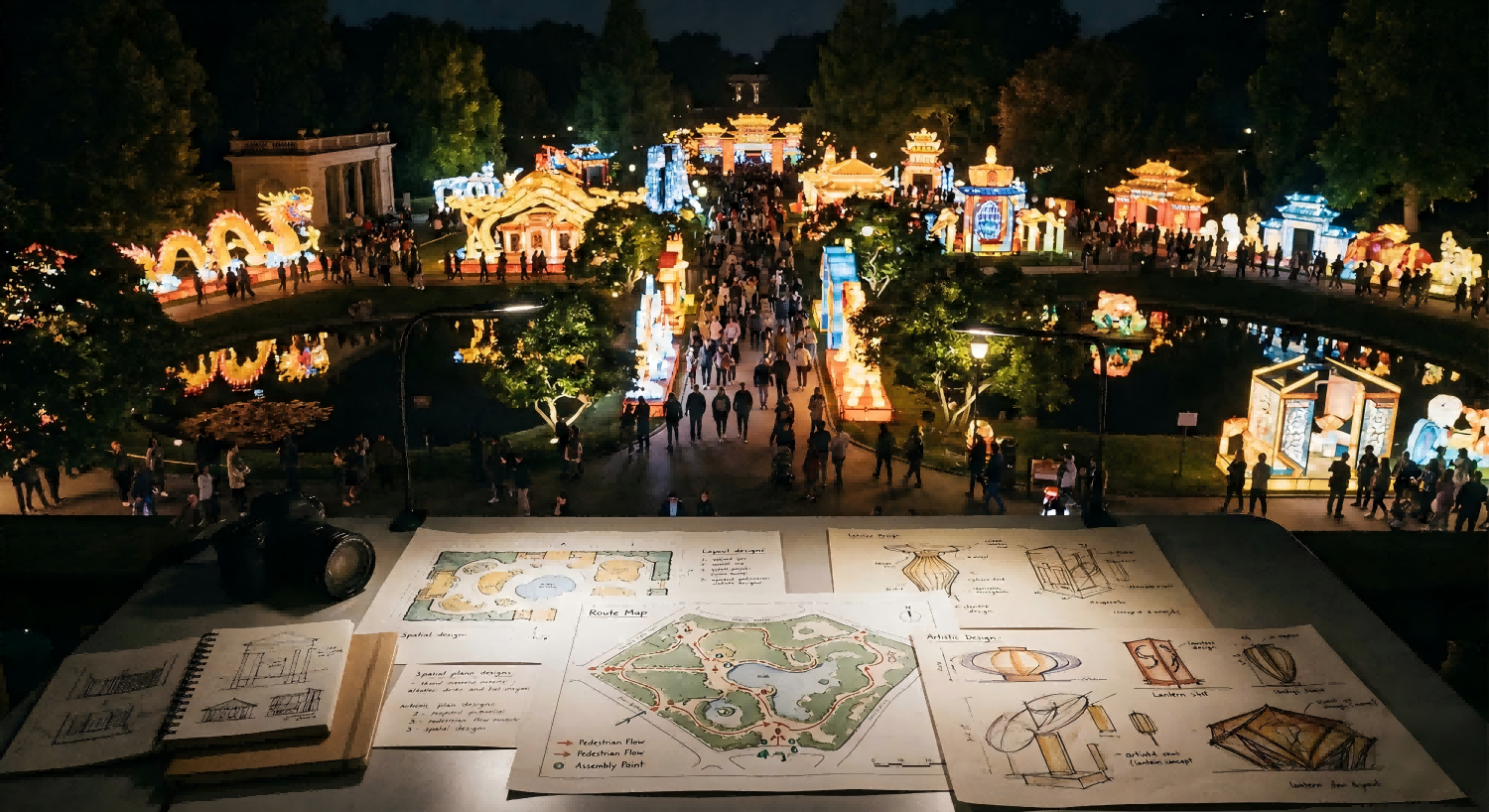
2. Study the Park as a Nighttime Site, Not Just a Daytime Landscape
Parks behave differently after dark. Sightlines shorten, shadows become more prominent, slopes feel steeper, and some routes that appear comfortable during the day may feel unclear at night. This is why lantern show planning should begin with a nighttime reading of the site rather than relying only on daytime impressions.
A strong site review considers more than available space. It should include entrance visibility, path width, surface conditions, existing trees, water edges, elevation changes, drainage, power access, emergency routes, and areas where crowding may naturally occur. Features that are visually beautiful can still create practical challenges. For example, a lakeside path may produce dramatic reflections, but it may also require stronger barriers, more careful circulation, and closer supervision.
At this stage, planners benefit from reviewing how the venue is used as a complete environment. Issues such as route hierarchy, technical access, and staging zones often become easier to manage when considered early. Broader event planning factors can also be understood through related site preparation work, such as park event planning principles and layout coordination in public display projects.
The most effective lantern shows do not force a generic layout onto every park. They adapt to the actual nighttime logic of the site.
3. Create a Route That Feels Natural, Clear, and Memorable
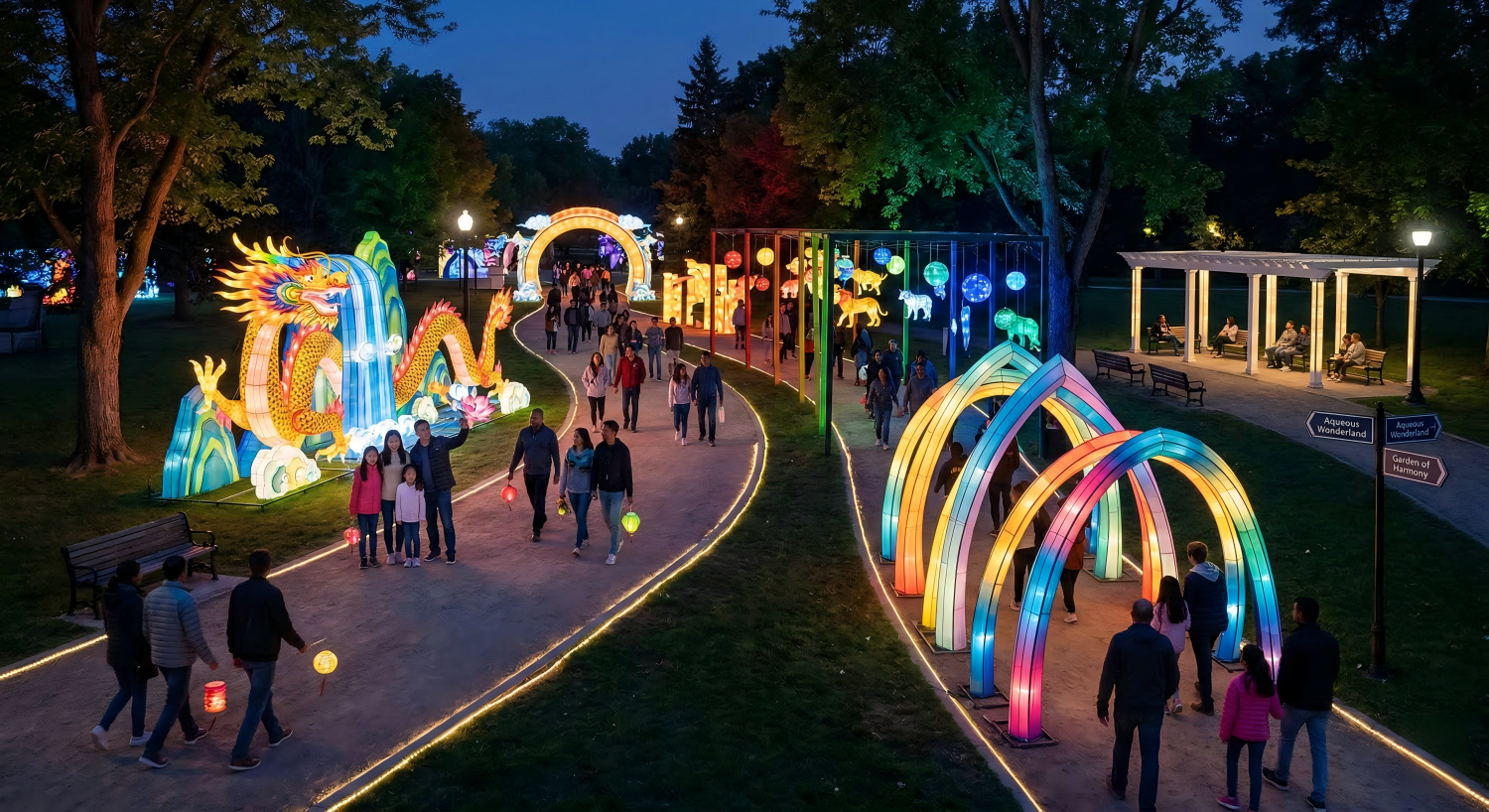
A lantern show is experienced in motion. Visitors do not absorb it all at once. They walk through it, pause, take photographs, adjust to changing light levels, and respond to how one scene leads into the next. Because of this, route planning is one of the most important parts of the whole project.
A successful route should feel intuitive. People should understand where to go without constant signage or hesitation. At the same time, the route should not feel flat or repetitive. It needs rhythm. In most strong lantern show layouts, visitors move through a sequence that includes orientation, buildup, highlights, transitions, and a satisfying conclusion.
Useful route planning considerations include:
- total walking time
- entry and exit logic
- rest points
- photo-taking interruptions
- accessible circulation
- alternative bypass routes for operations or emergencies
Spacing also matters. If all major lantern pieces are concentrated too closely together, the experience becomes visually exhausting. If the route contains long empty gaps, visitors may lose engagement. A good route often alternates between denser immersive sections and more open transitional spaces, allowing visitors to reset before reaching the next major moment.
4. Choose a Theme That Can Sustain the Entire Site
A good lantern show theme is not just a title. It is a structure that supports the entire experience. It should be able to connect large landmark pieces, medium-sized scenes, smaller decorative elements, signage, color logic, and the emotional tone of the event. If a theme only works for one or two beautiful scenes, it may not be strong enough for a full park route.
To test whether a theme is usable, planners should ask several practical questions. Can it be developed into multiple zones without feeling repetitive? Can it support both visual variety and a coherent overall identity? Is it understandable to a general audience? Does it fit the cultural, ecological, or seasonal context of the park?
In many cases, themes work best when they are based on one of three foundations:
- a recognizable cultural story or tradition
- local landscape, ecology, or city identity
- a broad imaginative world that can expand into sub-scenes
The goal is to build a theme that gives visitors both unity and contrast. They should feel that the whole event belongs together, while still discovering changes in mood, scale, and visual language from one zone to the next.
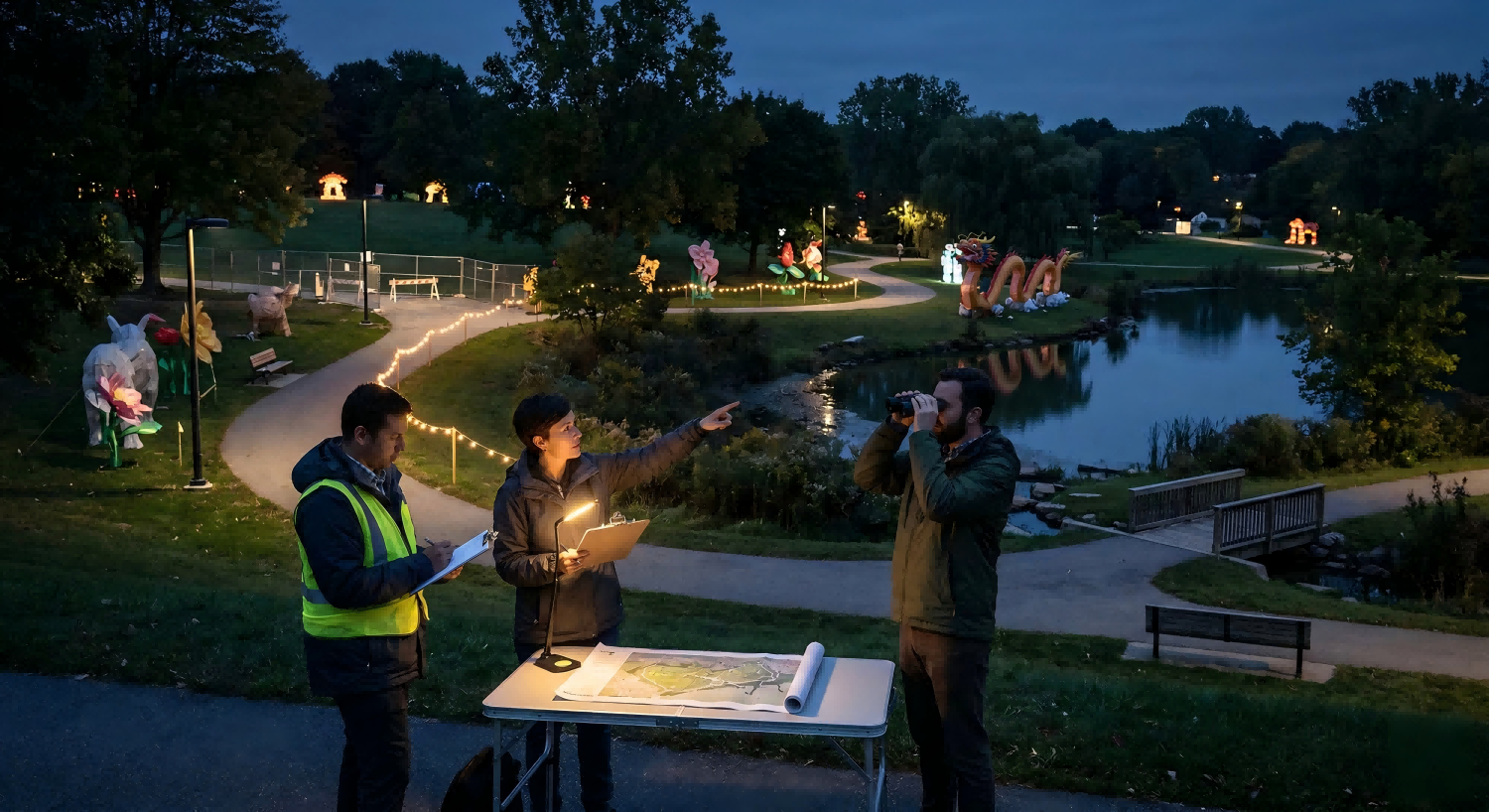
5. Integrate Safety and Operations From the Start
In weak projects, safety is treated as something to check after the design has already been finalized. In stronger projects, safety and operations are considered at the same time as the creative layout. This approach usually leads to a smoother installation, fewer compromises, and a better visitor experience.
A park lantern show is a public nighttime environment. That means planners must think about structural stability, electrical safety, cable management, weather exposure, trip hazards, emergency access, crowd control, and maintenance routines. Even visually successful lantern scenes can become operational failures if they block circulation, create blind corners, or prevent staff from reaching them for inspection.
Important operational questions include:
- Are technical routes separated from visitor paths where possible?
- Can staff access display areas for inspection and repair?
- Will surfaces remain safe in rain or humidity?
- Are queue-prone photo areas given enough space?
- Can emergency personnel enter and exit the site efficiently?
Operational thinking is also closely connected to how temporary display environments are built and maintained on site. Considerations such as installation sequence, maintenance access, and control points are easier to understand when planners also study how on-site production and setup workflows affect the final visitor environment.
6. Plan Around Visitor Behavior, Not Just Attendance Numbers
Attendance projections are useful, but numbers alone do not explain how a lantern show will actually function. What matters on the ground is behavior. Some visitors move quickly. Others stop at nearly every scene. Families often cluster around interactive features. Social media habits can turn one lantern into a high-delay photo point even if it was not designed as the central highlight.
This is why planners should focus on behavioral pressure points instead of overall capacity alone. A moderately attended event can still feel congested if several popular scenes are placed on narrow paths. A busy event can still feel comfortable if stopping zones, viewing pockets, and route width are handled well.
Useful questions include:
- Where are people most likely to stop for photos?
- Which scenes may attract children for longer periods?
- Where might groups slow down unexpectedly?
- Which parts of the route need more space for strollers or wheelchairs?
- Where might visitors hesitate or try to reverse direction?
A successful lantern show quietly guides behavior through spacing, visibility, and route clarity. Visitors should feel comfortable and free, even when the experience is carefully managed.
7. Evaluate the Show After Opening and Improve From Real Use
Planning does not end on opening night. Once the lantern show is live, the site begins to reveal whether earlier assumptions were correct. Some scenes may draw more attention than expected. Some transitions may feel too dark or too empty. Some routes that looked balanced on paper may perform poorly once real visitor movement begins.
Post-opening evaluation is one of the most valuable stages in professional event planning. It helps improve the current show and makes future editions stronger. Teams should observe not only technical performance, but also visitor flow, crowding points, staff workload, maintenance frequency, and the practical clarity of signage and circulation.
Useful areas for review include:
- route efficiency
- congestion points
- most photographed scenes
- underused or weak zones
- maintenance and repair patterns
- accessibility performance
- average visitor dwell time
Even a well-planned lantern show can reveal surprises during operation. The most successful organizers treat these observations as part of the project rather than as afterthoughts.
Conclusion
A successful park lantern show is the result of structured planning rather than decoration alone. The strongest projects begin with a clear purpose, respond to the park as a nighttime environment, guide visitors through a coherent route, use themes that can support the whole site, integrate safety and operations early, account for real visitor behavior, and continue improving after opening.
When these elements work together, a lantern show becomes more than a temporary visual display. It becomes a complete nighttime experience that feels immersive, coherent, and well managed from beginning to end.
Frequently Asked Questions
1. What is the first step in planning a park lantern show?
The first step is defining the purpose of the event. Before selecting themes or lantern styles, organizers should decide whether the show is intended for cultural celebration, seasonal tourism, public recreation, educational programming, or general nighttime activation.
2. Why is nighttime site analysis important for a lantern show?
A park can function very differently after dark. Visibility, path clarity, safety perception, slope conditions, and crowd movement all change at night. Studying the site in nighttime conditions helps planners identify practical issues that may not be obvious during the day.
3. How long should a park lantern show route be?
There is no single ideal length, but the route should be long enough to create progression without causing fatigue. The right length depends on visitor type, park size, number of major scenes, rest opportunities, and how often people are likely to stop for photographs.
4. What makes a lantern show theme effective?
An effective theme can support the entire site rather than only a few scenes. It should allow visual variety, remain understandable to visitors, and connect naturally with the park setting, the event season, or the intended cultural narrative.
5. Why should operations be considered early in the planning stage?
Operations affect the visitor experience just as much as design does. Maintenance access, safe wiring, emergency routes, crowd flow, and inspection routines are easier to manage when they are included in the layout from the beginning rather than added later.
Post time: Mar-18-2026


