

Many scenic areas already have something valuable: a natural walking route, a lake path, a garden trail, a mountain footpath, a cultural street, or a sequence of small viewpoints. During the day, these spaces may already guide visitors from one point to another. But after dark, the same route often becomes quiet, underused, or difficult to operate as a visitor experience.
This is where a scenic area light show can create real value. Instead of treating lighting as simple decoration, a well-planned night tourism project can turn an existing walking route into a complete after-dark attraction. The goal is not only to make the site brighter. The goal is to make visitors want to enter, keep walking, take photos, slow down at key points, and remember the route as an experience.
For parks, scenic areas, resorts, botanical gardens, cultural destinations, and tourism districts, this approach is often more practical than starting from zero. The route already exists. The visitor movement already has a basic direction. The challenge is how to rebuild the journey with light, storytelling, safety, and operational logic.
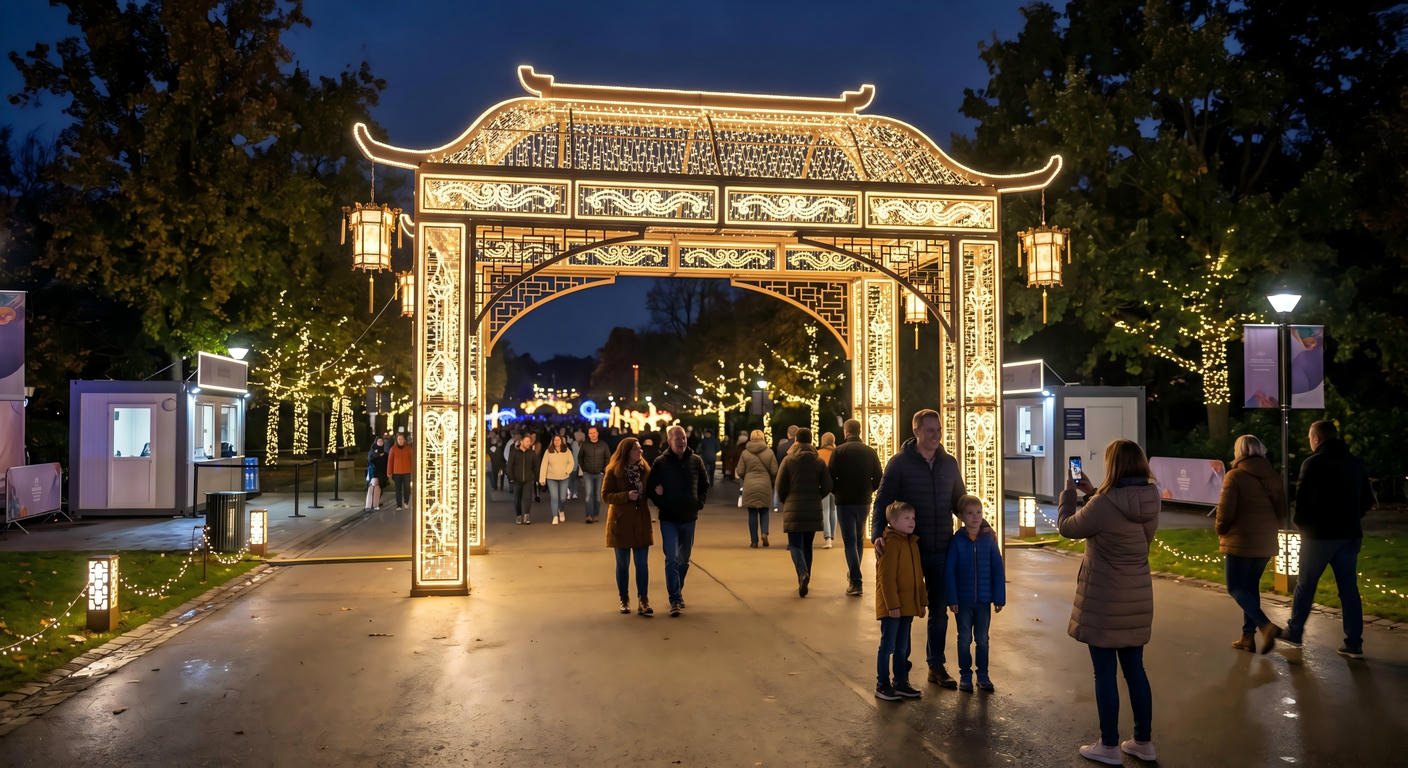
Why Existing Walking Routes Are Valuable for Night Tourism
A strong night tourism light show does not always require a completely new venue. In many cases, the best starting point is a path visitors already understand during the day. Existing walking routes usually have natural advantages: entrances, resting points, scenic views, open lawns, bridges, water edges, forest sections, or landmark buildings.
These spaces already provide rhythm. Visitors move, stop, look around, and continue. That rhythm is exactly what a nighttime attraction needs.
However, daytime logic and nighttime logic are not the same. In daylight, people can rely on natural views, signs, and open visibility. At night, visitors need stronger guidance. They need to feel safe, curious, and emotionally rewarded at different points along the route. A dark path with a few random lights is not a light show. A route with clear visual order, photo points, theme transitions, and comfortable movement can become a ticketed night attraction.
The First Step: Read the Route Before Designing the Lights
Before adding lanterns, tunnels, arches, or illuminated sculptures, the most important step is to understand the existing route. A scenic area should not ask only, “Where can we put lights?” A better question is, “How do visitors naturally move through this place, and where should the night experience begin, rise, pause, and end?”
In practical light show planning, the route should usually be reviewed from several angles:
- Where do visitors enter and exit?
- Which areas are naturally suitable for photos?
- Which sections feel too empty, too dark, or too long at night?
- Where can visitors pause without blocking the flow?
- Which spaces can support larger lantern groups or themed installations?
- Where are power access, emergency access, and crowd control easier to manage?
This route reading stage prevents a common mistake: designing beautiful individual displays without building a complete journey. A single large installation may look impressive, but if the path before and after it feels weak, visitors may remember only one spot instead of the whole experience.
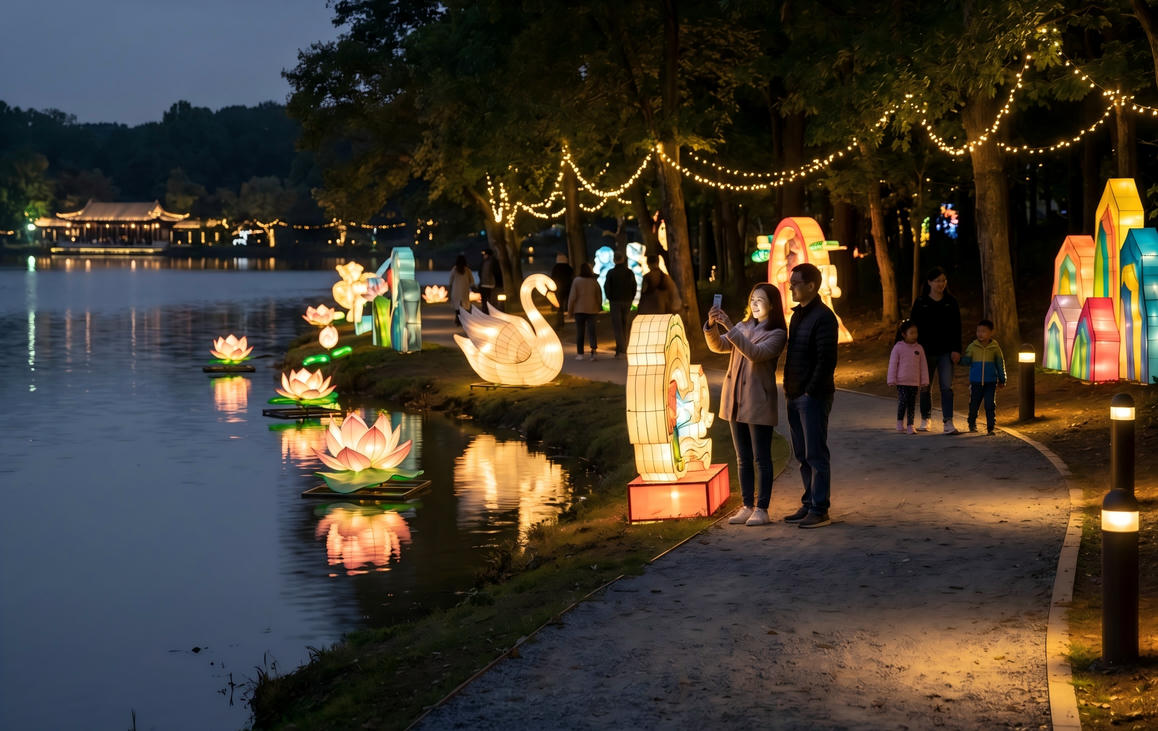
Build the Night Route Like a Story, Not a Straight Line of Decorations
A good scenic area light show should feel like a journey. It does not need to tell a complicated story, but it should give visitors a sense of progression. The route can begin with anticipation, move into stronger visual scenes, offer moments of interaction, and finally end with a memorable closing scene or commercial exit area.
One simple structure works well for many scenic areas:
- Entrance impact: a clear gateway, welcome arch, themed sign, or first photo point.
- Transition path: softer landscape lighting, small lanterns, tree lights, or guiding elements.
- Main scene: the strongest lantern group, lake reflection scene, animal theme, cultural theme, or fantasy installation.
- Interactive zone: photo frames, walk-through tunnels, wings, touch-friendly visual points, or family-friendly elements.
- Rest and service area: food, souvenirs, benches, small performances, or sponsor booths.
- Final memory point: a closing visual landmark that encourages one last photo before visitors leave.
This structure helps the light show feel complete. It also helps visitors understand where they are inside the experience. Without this sense of order, even expensive decorations may feel scattered.
Use the Existing Landscape Instead of Fighting Against It
Many scenic areas have strong natural or built features: water, trees, bridges, slopes, rocks, plazas, pavilions, gardens, or historic-style buildings. A successful night tourism light show should work with these features instead of covering them with unrelated decoration.
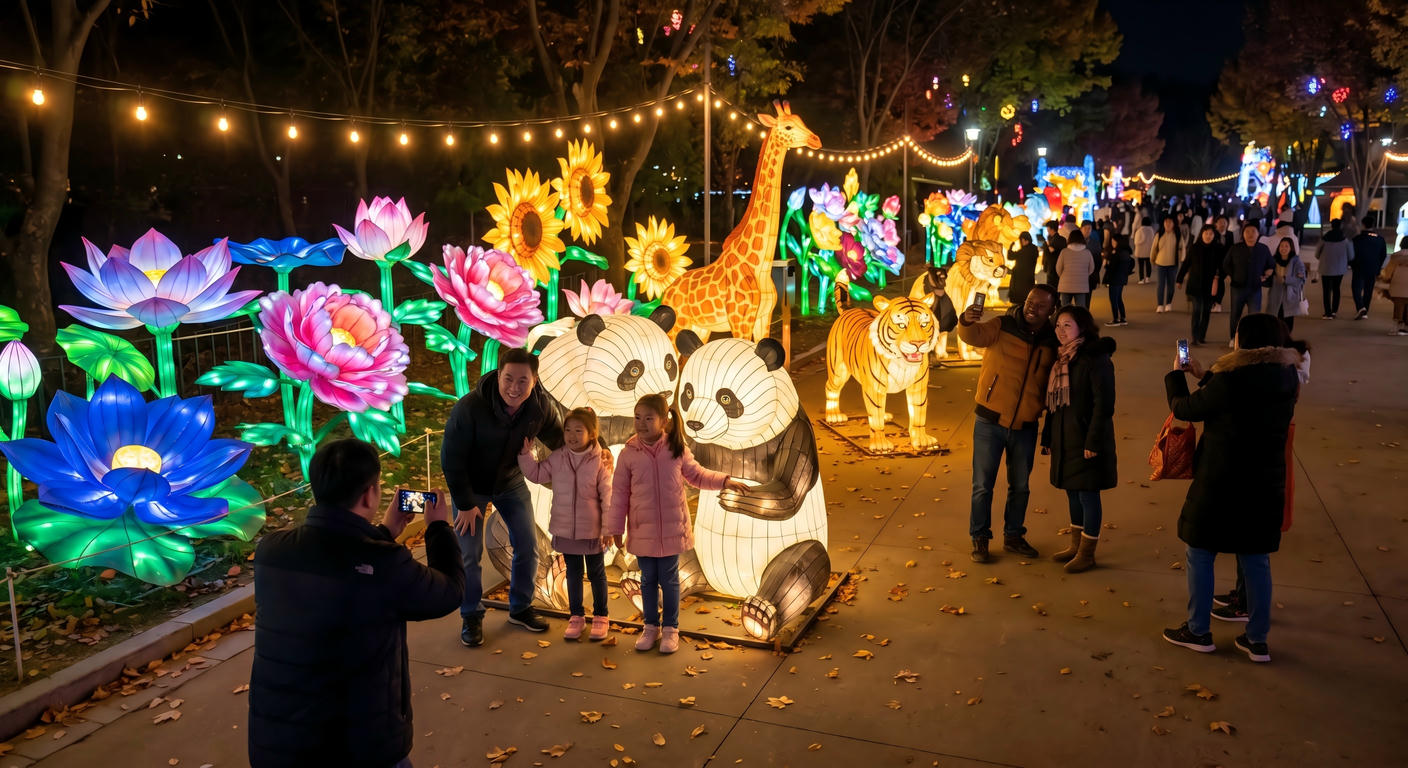
For example, a lake path can use reflection as part of the visual design. A forest trail can use softer lights, glowing flowers, animal lanterns, or hidden fantasy elements to create discovery. A bridge can become a transition gate between two theme zones. A large lawn can support a centerpiece lantern group, while a narrow path may be better for small guide lights or overhead decorative elements.
This is also why custom design matters. The same lantern display may not work equally well in every venue. A display that looks strong in an open plaza may feel too crowded in a narrow garden path. A tall installation may be perfect for an entrance square but unsuitable under dense trees. The route, scale, viewing distance, and visitor behavior should shape the final design.
Choose a Theme That Fits the Scenic Area
A scenic area light show becomes more convincing when the theme fits the place. Not every venue needs a traditional lantern festival theme. Some sites are better suited for nature, flowers, animals, ocean, fantasy, local culture, seasonal festivals, or family entertainment.
For example:
- A botanical garden may use flowers, butterflies, glowing trees, and nature-inspired lanterns.
- A zoo or animal park may use animal lanterns, interactive creatures, and educational scenes.
- A lake scenic area may use fish, lotus, moonlight, bridges, and reflection-based design.
- A cultural tourism site may use local myths, historic symbols, traditional patterns, or festival stories.
- A family resort may use cartoon characters, tunnels, photo wings, and playful illuminated sculptures.
The theme does not need to be complex. It needs to be clear. Visitors should understand the emotional direction of the route within the first few minutes. Is it romantic? Festive? Cultural? Magical? Educational? Family-friendly? Once the theme is clear, every major installation can support the same direction.
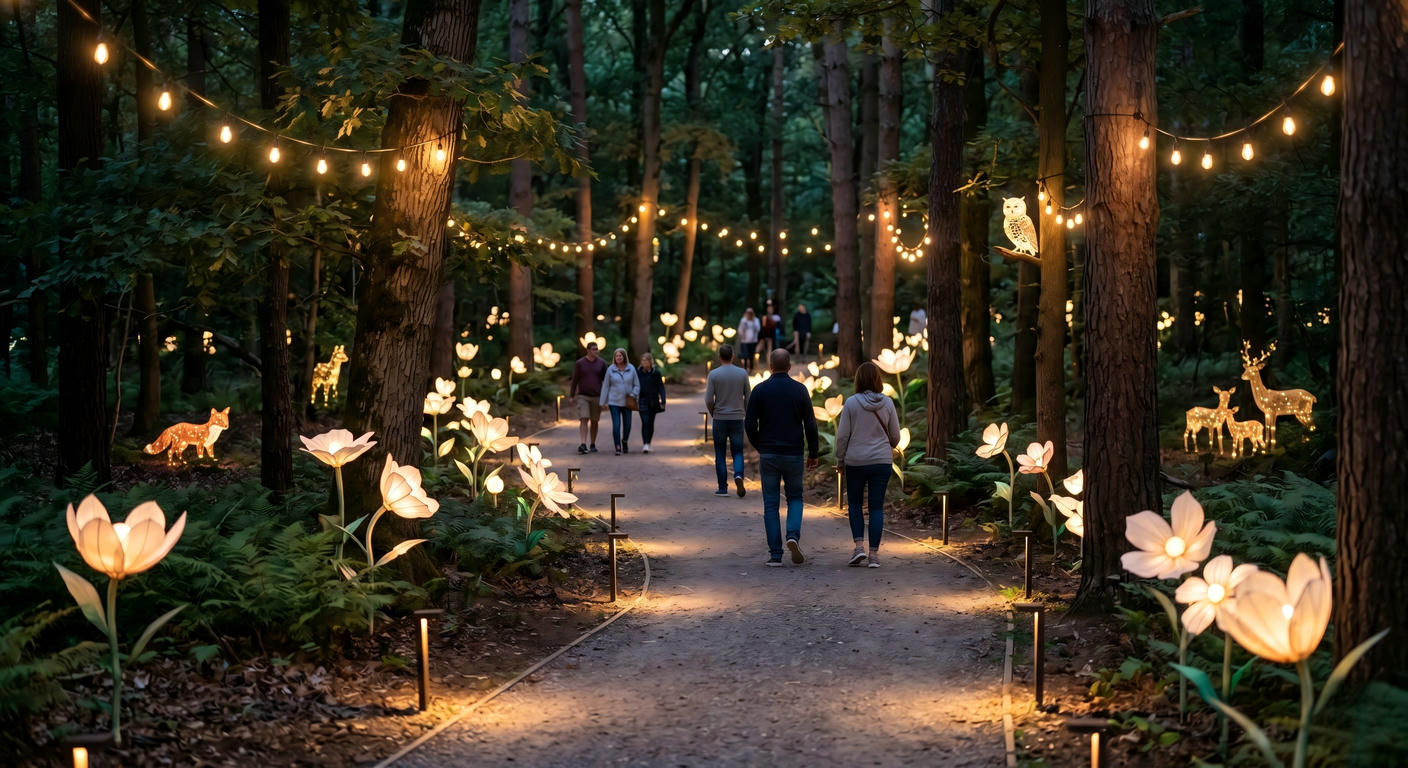
Control the Distance Between Photo Spots
One of the biggest differences between ordinary lighting decoration and a real park light show is the control of visitor attention. If all the best scenes are placed at the entrance, the rest of the route may feel weak. If the distance between attractions is too long, visitors may lose interest. If every corner is overloaded, people may feel tired and the photos may become visually messy.
A practical method is to arrange the route with a rhythm of “walk, discover, stop, photograph, continue.” Visitors should not need to walk too long before reaching the next visual reward. At the same time, each photo point should have enough space for people to stop without blocking others.
In many scenic areas, a strong photo spot every few minutes of walking is more effective than placing all major installations in one area. This rhythm keeps the experience moving and encourages visitors to explore the full route instead of leaving after the first scene.
Do Not Ignore Basic Lighting and Safety
A night tourism project must be beautiful, but it must also be comfortable and safe. Visitors may include families with children, elderly guests, tourists unfamiliar with the site, and people taking photos while walking. If the route is too dark, uneven, confusing, or crowded, the visual effect alone will not save the experience.
Basic illumination should be planned together with decorative lighting. Path edges, steps, slopes, water edges, bridges, exits, emergency routes, and service areas need clear visibility. The decorative atmosphere should not make the route unsafe.
For larger projects, electrical planning, waterproofing, wind resistance, installation access, maintenance points, and opening-night testing are also important. If your team is already reviewing site conditions, this lantern festival installation guide for parks and scenic areas can be used as a companion reference.
Plan Commercial Nodes Without Making the Route Feel Too Commercial
A night tourism light show is not only a visual project. For many venues, it must also support ticket revenue, food and beverage sales, souvenirs, sponsorship, or seasonal events. But commercial areas should be placed carefully.
If sales booths appear too early, visitors may feel the event is more like a market than a scenic experience. If commercial areas are too hidden, the venue may lose spending opportunities. A better approach is to place commercial nodes near natural pause points: after a major scene, near a rest zone, close to a small performance area, or before the final exit.
This keeps the route comfortable while still creating business value. Visitors are more willing to buy food, drinks, or souvenirs when they already feel relaxed and emotionally engaged by the show.
When a Venue Partnership Model May Be Suitable
Some scenic areas want to launch a light festival but hesitate because of investment pressure, design uncertainty, or lack of event operation experience. In these cases, a venue partnership for light festivals may be worth evaluating.
This model is not suitable for every venue. It depends on visitor traffic, location, operating season, ticketing potential, and local marketing ability. But for scenic areas with strong location advantages and underused nighttime capacity, partnership can reduce the pressure of starting alone.
The important point is to evaluate the route and market together. A beautiful site is not enough. A good night tourism project also needs a clear visitor path, realistic ticket positioning, marketing support, operating staff, and a design that matches the audience.
How This Differs from a Traditional Lantern Festival
A traditional lantern festival often focuses on large lantern groups, cultural themes, and festival atmosphere. A scenic area route-based light show may include lanterns, but it is not limited to traditional lantern displays. It can combine lantern sculptures, light tunnels, landscape lighting, interactive photo spots, seasonal decorations, projection elements, and local scenic features.
This broader approach is useful because many modern venues do not want a single fixed definition. They want an attraction that can fit their landscape, audience, budget, and season. For some parks, a lantern festival for parks is the right model. For others, a mixed night tourism light show built around an existing walking route may be more flexible.
A Practical Checklist Before Starting
Before a scenic area decides to build a night tourism light show, the project team should prepare several basic details:
- A map of the visitor route, including entrance, exit, and possible emergency paths.
- Photos or videos of the site during both daytime and nighttime.
- Estimated route length and expected walking time.
- Key scenic features that should be highlighted after dark.
- Potential areas for main installations, photo spots, food, rest, and ticket control.
- Basic information about local visitor groups and peak seasons.
- Power access points and any known restrictions from the venue.
With this information, the early design conversation becomes much more practical. The discussion moves away from vague questions like “Can you make it beautiful?” and toward more useful questions: “Where should visitors stop?” “Which scene should become the memory point?” “How long should the route feel?” “What kind of theme fits this site?”
Conclusion: The Route Is the Product
For scenic areas, the most valuable part of a night tourism light show is not always a single giant installation. It is the complete route. Visitors remember how the experience begins, how the atmosphere changes while they walk, where they take photos, where they rest, and what they feel before leaving.
That means an existing walking route can become a strong nighttime attraction when it is planned with clear structure, suitable themes, safe lighting, good photo rhythm, and realistic operation. A scenic area does not always need to rebuild itself. Sometimes, it only needs to rediscover its route after dark.
ParkLightShow works with parks, scenic areas, resorts, and outdoor venues to evaluate routes, create custom light show concepts, and provide practical project planning support. If your venue already has a walking path, garden route, lake trail, or open scenic space, it may already have the foundation for a memorable night tourism light show.
FAQ
1. What is a scenic area light show?
A scenic area light show is a nighttime attraction created inside a tourism site, park, garden, resort, or cultural destination. It uses lanterns, decorative lighting, illuminated sculptures, tunnels, landscape lighting, and themed scenes to turn the venue into an after-dark visitor experience.
2. Does a scenic area need a large open space for a night tourism light show?
Not always. A large open space can support bigger installations, but many successful projects are built along existing walking routes, lake paths, garden trails, plazas, bridges, or forest paths. Route quality, visitor flow, and theme planning are often more important than size alone.
3. How is a route-based light show different from simple landscape lighting?
Simple landscape lighting mainly improves brightness and atmosphere. A route-based light show is planned as a visitor journey, with entrance impact, themed scenes, photo spots, transitions, rest areas, and a clear emotional rhythm from start to finish.
4. Can lanterns be combined with other types of lighting?
Yes. Lanterns can be combined with light tunnels, tree lighting, ground lights, illuminated sculptures, interactive photo spots, and seasonal decorations. A mixed approach often works better for scenic areas because it can adapt to different spaces along the route.
5. What should a scenic area prepare before requesting a light show plan?
The venue should prepare a route map, site photos, estimated walking time, visitor capacity, power access information, key scenic features, and basic business goals. This helps the design team create a more realistic and useful proposal.
6. Is a venue partnership model possible for scenic area light shows?
It can be possible if the venue has suitable visitor traffic, strong location advantages, and practical operating conditions. A partnership model should be evaluated based on route quality, local market demand, operating season, ticketing potential, and marketing support.
Post time: Apr-26-2026


