

Many park lantern shows look impressive at the concept stage. The renderings are attractive, the theme feels clear, and the visual promise is strong. But once a project moves into fabrication, shipping, installation, testing, and public operation, success depends far less on the initial image alone. In real projects, quality is often determined by whether key delivery details were understood early enough, not by whether the original concept looked exciting on screen.
For park owners, scenic area operators, venue managers, and event contractors, a successful lantern show is not simply a collection of illuminated sculptures. It is a temporary nighttime environment that must be buildable, safe, visually coherent, operationally manageable, and stable throughout the exhibition period. This article focuses on the implementation stage between design approval and opening night, where many avoidable problems begin to surface.

1. Delivery quality depends on how early uncertainty is reduced
In many projects, the design phase receives the most attention because it is the easiest stage for everyone to discuss. Themes, hero pieces, color palettes, and route concepts are all visible in a rendering. But once execution begins, the conversation changes. The key questions become practical: Can the design be built within the schedule? Can it fit the actual site? Can it be installed safely and tested properly? Can it remain stable during operation?
This is why implementation should not be treated as the final step after design. In a mature project, execution logic begins during design review. Fabrication, logistics, site access, structural behavior, power distribution, testing windows, and maintenance conditions should all influence decisions before production starts. A lantern show that only works on paper will almost always lose clarity, quality, or efficiency during delivery.
If your team is still at the early planning stage, it helps to first define the project purpose, visitor route, and nighttime site logic before moving deeper into execution details. Our related article on how to plan a successful park lantern show looks at that earlier strategic layer.
2. Site input quality affects the entire implementation chain
One of the most common reasons a lantern show becomes difficult to deliver is that the site information provided at the beginning is incomplete, outdated, or too general. A project team may know the venue size in broad terms, but that alone is not enough to support accurate execution decisions.
What matters in real implementation is the quality of the site input. Is the ground level or sloped? Are there elevation changes that affect visibility and anchoring? Are there trees, existing structures, or permanent lighting sources that interfere with sightlines? Where are the real power access points? How close can trucks or lifting equipment get to the main installation areas? Which paths must remain clear for emergency access or public circulation?
When these conditions are not properly understood, the design may remain visually attractive while becoming increasingly difficult to execute. A hero piece may arrive at the site and feel underscaled or oversized. A photo point may be blocked by vegetation. A route that seemed intuitive in the rendering may conflict with real pedestrian movement. A power layout that looked simple in principle may become expensive and inefficient on site.
For that reason, better site readiness is not just a technical requirement. It is one of the most effective ways to reduce later revisions, delay risk, and uncontrolled cost expansion.
3. The biggest gap between rendering and reality is often scale, not color
When people talk about render-to-reality differences, they often focus on color, brightness, or decorative finish. Those details matter, but in park lantern show projects, the most damaging mismatch is usually the relationship between scale, spacing, and viewer perspective.
A centerpiece that looks dramatic in a rendering may feel crowded once placed near existing trees or narrow pathways. A themed scene that reads clearly from one camera angle may lose impact when seen from the actual visitor entry route. A walk-through installation may appear immersive in design files but become visually compressed if stopping points, photo behavior, and human scale were not fully considered.
That is why design approval should not only ask whether the drawing looks beautiful. It should ask whether the design remains convincing under real viewing conditions. Can the primary piece hold attention from the first approach? Are transition zones between scenes long enough to create rhythm? Will close-range photographs still feel intentional? Does the composition work both in daylight and after dark?
The purpose of design confirmation is not simply to approve an image. It is to narrow the gap between rendering logic and site-viewing logic before production begins.
4. Structural and electrical thinking should shape the design, not follow it
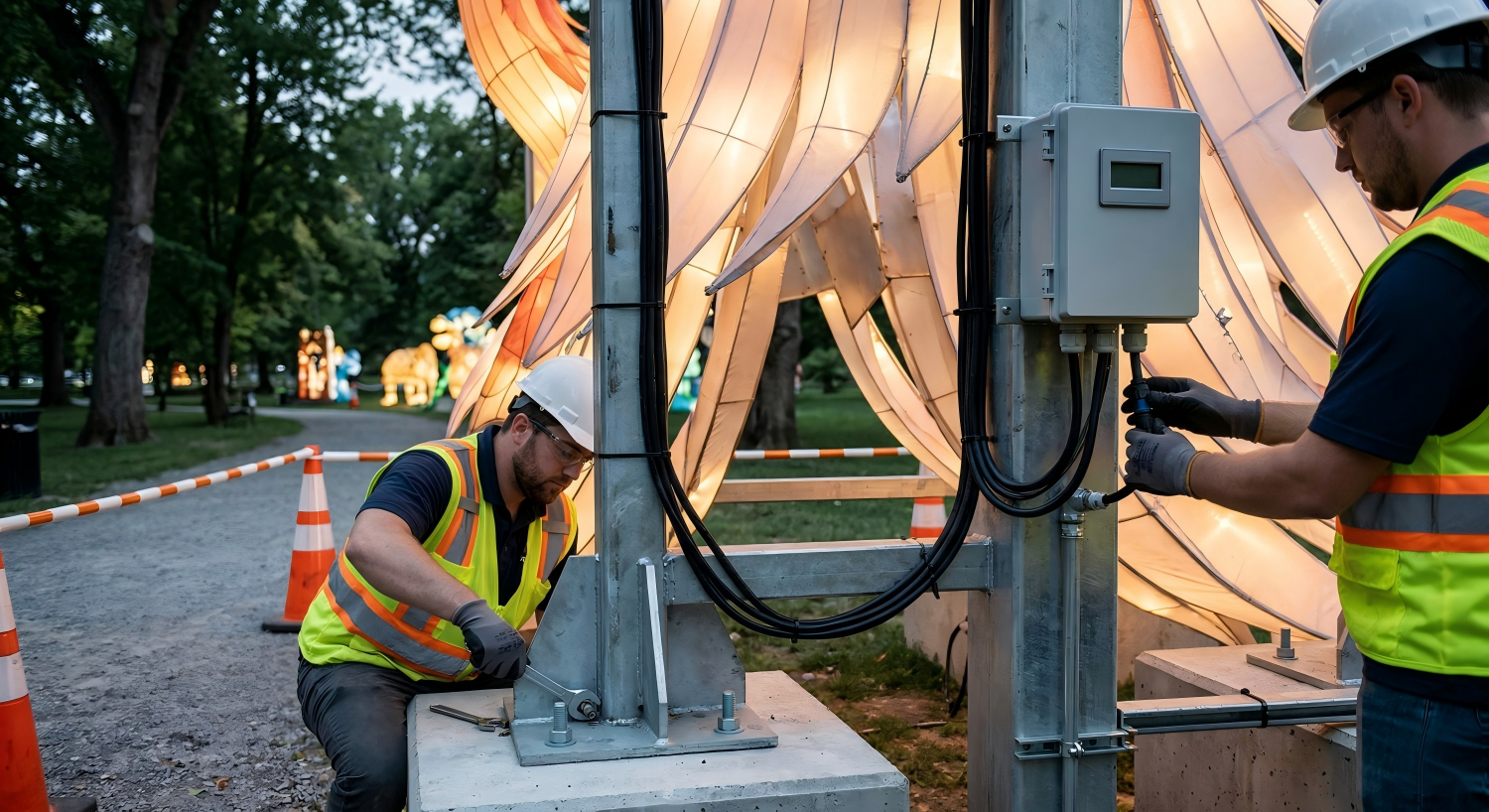
In a public park or scenic venue, every lantern installation is also a real structure in a real environment. That means structural stability and electrical planning should be part of the design evaluation from the start, not treated as a later compliance box to check.
Outdoor public projects face variables that indoor display environments do not. Wind exposure, rain, humidity, temperature variation, surface conditions, and visitor interaction all place pressure on the installation system. In some venues, the biggest challenge is not making a structure stand up once, but keeping it stable and maintainable throughout the exhibition period.
From an implementation perspective, several questions matter early:
- Is the support logic suitable for the actual ground condition?
- Do elevated or spanning elements require additional stability planning?
- Can the electrical circuits be divided in a way that supports troubleshooting?
- Are cable routes, connectors, and control points protected for outdoor use?
- Do the selected materials match the intended operating period and climate exposure?
Experienced buyers often discover that the problem is not whether a supplier says something can be built. The more important question is whether the structural, electrical, and maintenance logic can be explained clearly enough to support long-term operation.
For a more site-focused discussion of field delivery and setup conditions, see our installation guide for parks and scenic areas.
5. Logistics strategy affects installation speed as much as shipping cost
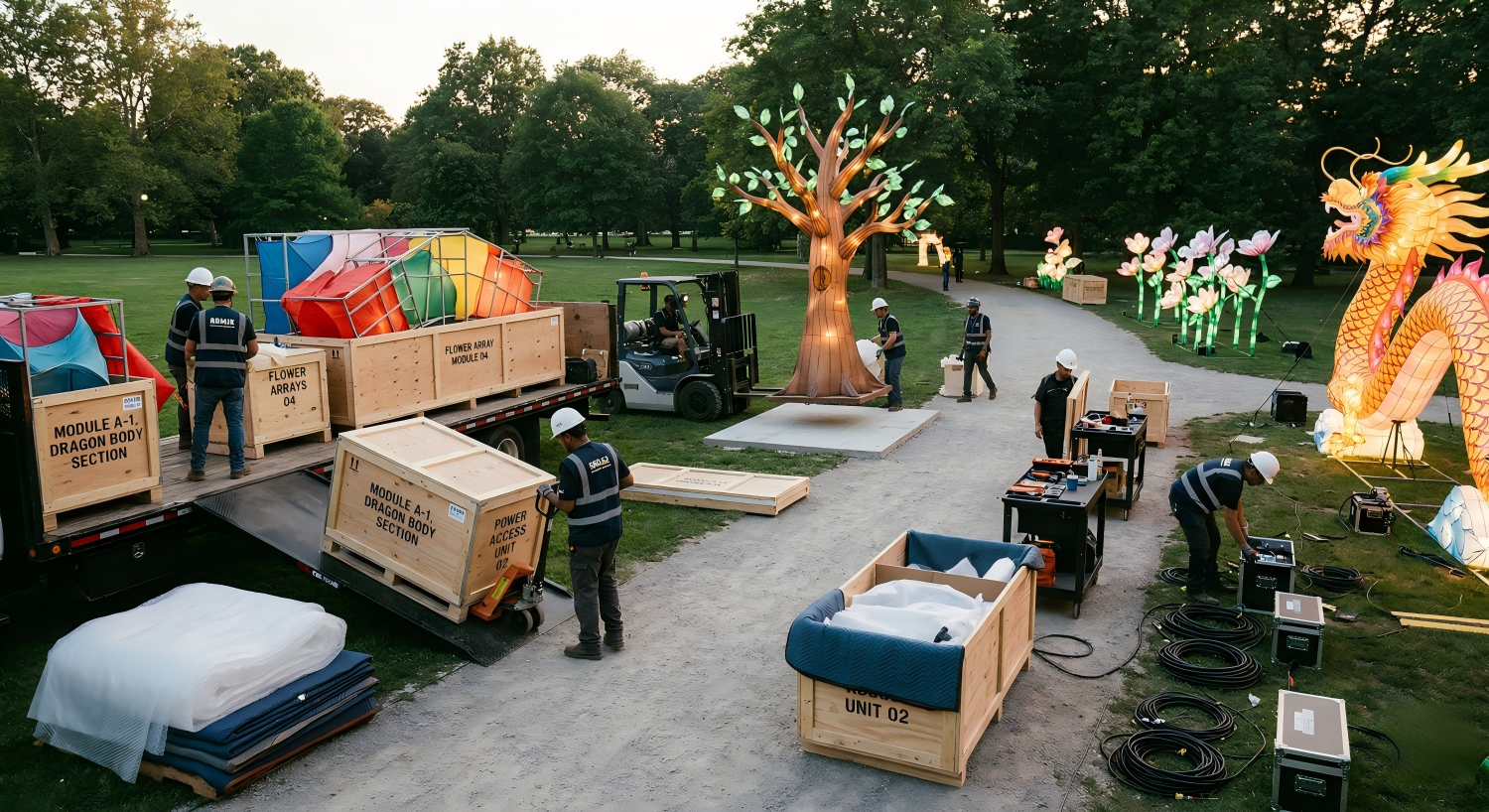
In large-scale lantern projects, logistics is not a separate afterthought. Shipping conditions directly influence fabrication logic, on-site sequencing, and labor efficiency. An installation that looks elegant in the factory can become difficult and slow in the field if it was not designed with transport and assembly in mind.
This is where modular thinking becomes important. Modular fabrication is not only about reducing freight volume. It also influences whether components can be identified quickly, whether connectors are easy to access, whether the installation order is intuitive, and whether later maintenance can be handled without excessive dismantling.
A practical logistics strategy should consider at least the following:
- Whether each module is small enough for real transport constraints
- Whether numbering and reassembly logic are clear
- Whether splitting the structure weakens the visual continuity
- Whether packaging supports both protection and efficient unpacking on site
- Whether key joints remain accessible for maintenance and adjustment
From a management perspective, poor transport planning rarely stays a freight issue. It usually becomes a schedule issue on site. Materials may arrive, but installation slows down because the pieces are hard to sort, hard to move, or hard to connect in sequence.
That is also why cost comparisons should never focus only on the headline number. Delivery logic, packaging complexity, installation conditions, and future reuse can all change the true value of a quotation. We discussed that in more detail in this guide to the hidden cost drivers behind park light show quotes.
6. Opening quality is decided during testing, not when installation ends
Many projects make the mistake of treating installation completion as project completion. In practice, the period between physical completion and opening night is often where quality is won or lost.
Visitors do not evaluate a lantern show based on whether the pieces were assembled quickly. They experience the project through rhythm, brightness balance, focus hierarchy, movement comfort, photo appeal, and operational stability. These qualities can only be checked properly through testing and night adjustment.
Before opening, the project team should allow enough time for:
- Brightness balancing across different zones
- Reviewing the visual hierarchy between hero pieces and supporting scenes
- Adjusting dynamic effects that feel too fast, chaotic, or visually tiring
- Testing music, interaction, and control synchronization where applicable
- Checking exposed cables, visible seams, and unfinished details in visitor view
- Confirming that photo points perform well under real nighttime conditions
If the project includes DMX or other programmable control systems, this phase becomes even more important. The biggest risks are often not within a single sculpture, but in how multiple zones, circuits, and timing systems interact under real operating conditions.
Projects that are expected to attract winter traffic or seasonal evening visitors should also think carefully about testing in relation to weather, comfort, and revenue rhythm. Our article on planning a successful winter lantern festival explores that wider operating context.
7. Maintenance planning is part of delivery quality
Maintenance is often discussed too late, even though it shapes the visitor experience throughout the exhibition period. A lantern show rarely fails because of one dramatic breakdown. More often, quality declines through a series of small unresolved issues: a partial lighting failure, a controller fault, local surface wear, loosened connection points, or weather-related inspection needs.
This is why maintenance logic should be established before opening. At minimum, the operating team should understand:
- What needs to be checked before opening each day
- What should be inspected after closing or after heavy weather exposure
- Which faults can be fixed on site and which require replacement parts
- Which components should be stocked as critical spares
- How reusable structures and decorative surfaces should be handled after closing
For venues that hope to reuse assets across seasons, maintenance is not a secondary service issue. It is part of the asset-life strategy. The question is not only whether a project can be reused, but how well it can be stored, rebuilt, and presented again without noticeable quality loss.
8. The real evaluation standard is not who can make lanterns, but who understands delivery
In park and scenic-area projects, design capability matters, and fabrication capability matters too. But when projects become complex, the strongest differentiator is often delivery judgment: the ability to connect concept, site conditions, engineering, logistics, testing, and operation into one working system.
That is why project decisions should not be based only on a rendering, a product list, or a single quote comparison. The more reliable indicator of future project quality is whether implementation details were considered early enough, communicated clearly enough, and organized realistically enough.
A well-delivered park lantern show does more than look impressive on opening night. It stays coherent under real site conditions, supports visitor movement, remains maintainable during operation, and reduces the gap between concept promise and public experience.
Conclusion
From concept rendering to opening night, the most important work in a park lantern show is often the least visible. Site accuracy, scale judgment, structural logic, logistics planning, testing discipline, and maintenance readiness all shape the final result. For park owners, scenic operators, and event contractors, the earlier these control points are brought into the process, the more stable, efficient, and convincing the project is likely to be.
Frequently Asked Questions
1. What site information should be prepared before design approval?
At minimum, the project team should gather recent site photos, layout drawings if available, visitor entry directions, ground condition details, power access information, and transport or construction access constraints. Better input usually leads to fewer revisions later.
2. Why do lantern show renderings sometimes look stronger than the finished site?
The most common reason is not weak craftsmanship but weak translation between drawing logic and real viewing conditions. Problems with scale, sightlines, spacing, tree cover, and route perspective often reduce the intended impact.
3. Is modular fabrication only about lowering freight cost?
No. It also affects assembly speed, unpacking efficiency, replacement access, maintenance convenience, and whether the project can be reused across future seasons with less disruption.
4. Why is a night test necessary if the installation is already complete?
Because many critical issues only become visible under real operating conditions. Brightness imbalance, uncontrolled movement effects, poor photo performance, and exposed finishing problems are often discovered only during night testing.
5. What makes a lantern show easier to operate over a longer exhibition period?
Clear maintenance routines, sensible circuit division, accessible repair points, spare-part readiness, and a realistic understanding of how the installation behaves under weather exposure and daily public use.
Post time: Mar-28-2026


